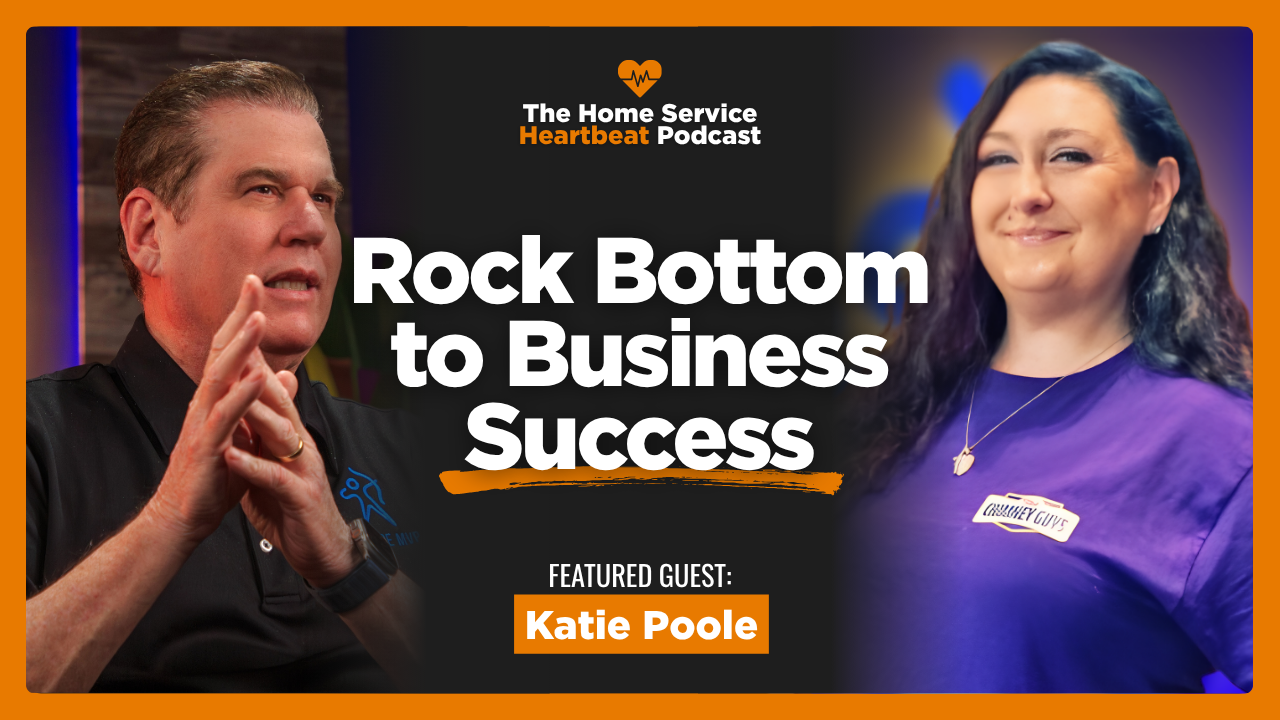
When Katie Poole restarted her father's chimney company in 2019, she wasn't executing a carefully developed business plan.
She was trying to survive.
Her father, Rob Harrison, had founded The Chimney Guys in 2004 and spent 14 years serving homeowners throughout the Columbus, Ohio, community. When he unexpectedly passed away in 2018, the company closed because Rob was the company. (The Chimney Guys)
About a year and a half later, Katie found herself at what she describes as rock bottom.
She was a single mother of four. She had lost her house. Her children had gone to live with their father. She filed for bankruptcy. Her car was facing repossession.
But Katie still had something she'd learned years earlier.
At 15 years old, her first job had been cold calling for the chimney company where her father worked.
So Katie pulled out her father's old customer records.
And she started calling.
That decision restarted The Chimney Guys.
Today, Katie and her husband Jesse lead a company of approximately 30 employees - and the business Katie originally rebuilt out of desperation has become something very different.
It's now a vehicle for creating opportunity for other people.
The Chimney Guys by the Numbers
Katie shared several details about how the company operates today:
- Approximately 30 employees
- New apprentices are expected to become certified within six months
- Certified technicians ideally perform only three initial inspection appointments per day
- Inspection reports can reach 78 pages on more complex homes
- Technicians can create a homeowner's chimney care plan on site approximately 98 - 99% of the time
- A dedicated warehouse and fleet coordinator prepares jobs in advance
- The company has expanded beyond traditional chimney sweeping into repairs, masonry, fireplace installations, gas systems and complete fireplace makeovers
Behind those numbers is a philosophy Katie comes back to throughout her conversation with Joe:
Invest in people.
How Do You Rebuild a Home Service Business From Rock Bottom?
Start with the skills and relationships you already have, then build from there. Katie Poole restarted The Chimney Guys with no crew or equipment - using her knowledge of the industry and her father's old customer records to begin reconnecting with the community.
Katie's relationship with the chimney industry started long before she became an owner.
At 15, she worked as a cold-call telemarketer for the chimney company where her father worked.
Those calls taught her sales, phone communication, perseverance and, as Katie puts it, "thick skin."
Years later, those skills became unexpectedly important.
After her father's death and the closure of The Chimney Guys, Katie eventually found herself needing a way forward.
She knew how to pick up a phone.
She knew her father's customers.
And she knew chimneys.
So she started over.
The Chimney Guys' own company history describes Katie as rebuilding the operation from the bottom with essentially no equipment or crew.
Then another part of the story came full circle.
Back in 2001, Katie's future husband Jesse had started working at the same chimney company where her father worked. In fact, Katie's dad was the first technician Jesse ever rode with in the field.
Nearly 20 years later, Jesse reentered Katie's life. He joined The Chimney Guys on May 1, 2020 - National Chimney Sweeps Day - and Katie and Jesse married that July.
How Did The Chimney Guys Grow to 30 Employees?
Katie attributes much of the company's growth to building an organization where people can develop personally and professionally. Rather than requiring every new hire to arrive as an experienced chimney professional, The Chimney Guys created a structured apprenticeship program that develops people into certified technicians.
This is where Katie's story becomes particularly relevant to other home service business owners.
She isn't simply trying to find experienced chimney technicians.
She's building them.
Katie specifically looks for people who are committed to growth.
The apprenticeship isn't easy. Employees work physically demanding days in all types of weather and are also expected to continue their education online. Apprentices need to earn their certification within six months.
That requires personal responsibility.
And that's precisely what Katie is looking for.
As she told Joe:
"The only people who are successful in that are the people who are dedicated to their own personal and professional development."
That's an important lesson for an industry that constantly talks about the skilled-labor shortage.
Sometimes the solution isn't finding more great technicians.
It's developing more great technicians.
????️ Hear Katie's Full Story on Home Service Heartbeat
This article highlights some of our favorite lessons from Joe Crisara's conversation with Katie Poole on the Home Service Heartbeat Podcast.
Hear Katie tell the remarkable story of rebuilding her father's company, growing to approximately 30 employees, developing technicians through apprenticeship and creating a business centered around opportunity for others.
Watch Katie Poole on the Home Service Heartbeat Podcast →
What Is the Most Important Leadership Lesson for a Growing Home Service Company?
Set extremely clear expectations for employees—and make those expectations work both ways. Katie credits much of her leadership growth to replacing traditional job descriptions with what The Chimney Guys calls a "position contract."
Katie readily admits she didn't always know how to lead.
Looking back at earlier stages of the company, there are situations she wishes she'd handled differently.
But those mistakes taught her.
One of the most important things she's learned is that employees need to know exactly what success looks like.
That's why The Chimney Guys doesn't rely solely on traditional job descriptions.
Katie uses position contracts.
A position contract establishes:
- What the company expects from the employee
- The employee's responsibilities
- The KPIs and OKRs used to measure performance
- How employees can know they're succeeding
- Compensation structure
- What the employee can expect from the company
That last piece matters.
Katie describes it as a mutual document.
The employee has obligations to the company, but the company also has obligations to the employee.
That's a concept that fits closely with what we teach in home service leadership training at Service MVP: accountability becomes much more effective when expectations are clear, measurable and understood by everyone involved.
How Do You Hire Home Service Employees When Skilled Technicians Are Hard to Find?
Hire people who are committed to learning and give them a structured path to competency. The Chimney Guys uses a demanding apprenticeship program that combines field experience with online education and requires certification within six months.
Katie isn't pretending the job is easy during recruiting.
Quite the opposite.
Candidates hear about the expectations from the job posting through the interview and onboarding process.
The work can mean long days, physically demanding labor, extreme temperatures and challenging roofs.
Then apprentices go home and continue studying.
Why make that so clear?
Because Katie isn't merely hiring someone to fill a truck.
She's looking for someone willing to invest in themselves.
That approach also gives The Chimney Guys an opportunity to hire people who might otherwise have been overlooked.
Katie talks openly about wanting the company to create opportunities for people who haven't always been dealt the best hand in life.
For her, employee development isn't just a recruiting strategy.
It's part of the company's purpose.
How Should Home Service Companies Diagnose Problems Before Offering Solutions?
Start with a thorough inspection that identifies the root cause before recommending work. The Chimney Guys trains certified technicians to document their findings, explain them in language homeowners understand and then develop a chimney care plan based on what they actually discovered.
This part of Katie's process overlaps beautifully with the Service MVP philosophy.
A homeowner may call because bricks are crumbling.
But simply quoting a brick repair doesn't necessarily solve the underlying problem.
Why are they crumbling?
The Chimney Guys begins most customer journeys with an inspection - or a chimney sweep and inspection, depending on the homeowner's needs.
A certified chimney sweep evaluates the complete system.
Then the technician reviews the findings with the homeowner on an iPad.
Katie says their inspection reports can become extremely comprehensive. One report involving three flues reached 78 pages.
But information alone isn't enough.
The technician has to translate those findings into something the homeowner can understand.
That's the difference between simply identifying a problem and professionally communicating a diagnosis.
How Do You Present Homeowners With Service Options Without Pressuring Them?
Diagnose first, explain what you've found and give the homeowner appropriate solutions so they can decide what's right for their family. The professional's responsibility is to create clarity - not to pressure the client into one predetermined answer.
Katie says her technicians can create a chimney care plan on the spot approximately 98 - 99% of the time.
They review why particular work may be recommended and help the homeowner understand the condition of the system.
Joe described that during their conversation as giving clients different solutions so they can choose what's right for their family.
Katie agreed.
That's very close to the options-based service philosophy we teach at Service MVP.
A home service professional shouldn't make the decision for the client.
The goal is to thoroughly investigate, explain what's happening, present meaningful choices and let the homeowner answer the ultimate question:
What should we do?
How Many Appointments Should a Home Service Technician Run Per Day?
The right number is the number that allows the technician to do the job thoroughly and answer the customer's questions without feeling rushed. For The Chimney Guys, the ideal target for initial inspection appointments is three per technician per day.
That number caught my attention.
Three.
Not six.
Not eight.
Not get out of that house because dispatch has another call waiting.
Katie deliberately gives certified technicians enough time to conduct a thorough inspection, connect with the homeowner and answer the questions necessary for the customer to make a well-informed decision.
Meanwhile, The Chimney Guys creates efficiency elsewhere.
Production work goes to a different team.
Jobs are reviewed ahead of time.
A warehouse and fleet coordinator prepares upcoming jobs so technicians can arrive in the morning, load what has already been prepared and get to work.
That's a great example of separating efficiency from rushing.
The operation should be efficient.
The customer shouldn't feel rushed.
How Do You Create a Five-Star Home Service Customer Experience?
Create trust before the technician arrives, communicate throughout the appointment and protect the customer's home as though it were your own. Great customer experience comes from hundreds of small, repeatable actions - not one grand gesture.
The Chimney Guys has intentionally designed those details into its process.
Their website says customers receive appointment confirmations, a reminder the day before service and a photo of the technician who will be coming to their home.
Once inside, Katie says technicians use booties, tarps, rug runners and high-speed dust collectors to protect the property.
And there's another piece of the customer experience that goes back a generation.
Katie remembers hearing from customers her father served years ago.
One story particularly stands out.
Her father once pulled a piece of red felt from a homeowner's chimney. The homeowner's grandson was there, so Rob gave it to him and told him Santa had torn his coat coming down the chimney.
Years later, the family still had that piece of felt sitting on the mantle.
The grandson- now in his late teens - still remembered it.
That's customer experience.
The service call ended years ago.
The memory didn't.
How Can Community Involvement Help Grow a Home Service Business?
Become a recognizable and trusted part of the community rather than simply advertising to it. Katie says The Chimney Guys generates business through community involvement, educational content, referrals, strong reviews and the visibility created by its trucks and yard signs.
The company volunteers with local organizations and makes donations within its community.
At the same time, it invests heavily in useful educational content.
The Chimney Guys' website contains extensive information about chimney sweeping, inspections, repairs, masonry, fireplace installations and common chimney problems. (The Chimney Guys)
Katie says customers increasingly tell them:
"I saw your truck."
"I saw your yard sign."
"My neighbor referred me."
Or they found the company through Google and noticed its strong reviews.
That's an important marketing lesson for home service companies.
No single channel has to do all the work.
Your trucks, employees, website, reviews, referrals, community involvement and educational content can all reinforce the same message.
What Happens When Your Core Home Service Market Starts Changing?
Expand your expertise before the market forces you to. The Chimney Guys is responding to fewer new homes being built with traditional chimneys by investing in gas-system training and expanding into fireplaces, makeovers and complete hearth installations.
Katie sees a significant shift happening in her industry.
Many newer homes use direct-vent gas fireplaces or electric fireplaces. Some don't have fireplaces at all.
So The Chimney Guys isn't waiting for the traditional chimney market to dictate its future.
The team is expanding its training around gas systems and increasing the scope of work it can perform.
Today, the company's offerings include traditional chimney cleaning and repair alongside fireplace inserts, gas and wood-burning products, electric fireplaces, fireplace makeovers, surrounds and mantels. (The Chimney Guys)
Katie says they can even build a complete chimney and fireplace for a home that doesn't currently have one.
That's a valuable lesson for virtually any home service company:
Your trade can evolve without abandoning what made you successful in the first place.
What's the Most Important Investment a Home Service Owner Can Make?
Invest in your people and their education. Katie believes continued personal and professional development is one of the most important responsibilities of a home service business owner.
When Joe asked Katie for the most important advice she'd give another service business owner, she didn't say marketing.
She didn't say software.
She didn't say trucks.
She said people.
Continuing education has become part of the culture at The Chimney Guys.
The company's website backs that up: technicians participate in continued classroom education and hands-on industry training, and the company maintains credentials including CSIA certification and membership in the National Chimney Sweep Guild.
Training isn't something employees complete so they can finally get to work.
Training is part of the work.
From Survival to Opportunity
Perhaps the most meaningful transformation at The Chimney Guys isn't its growth from essentially nothing to approximately 30 employees.
It's what the company means to Katie today.
She told Joe that when she restarted The Chimney Guys, she did it because she needed to survive.
Today, she says the business is no longer built out of desperation.
It's built around creating opportunities for other people.
Katie also speaks openly about the role her Christian faith plays in her leadership. She describes reconnecting with her faith after Jesse came back into her life and now strives to lead according to Matthew 5:16.
That faith-centered identity isn't merely something discussed on the podcast; The Chimney Guys publicly identifies itself as a faith-based, woman-led company, and its own company history honors Rob Harrison and the foundation he created.
Near the end of the episode, Joe asks Katie what she'd tell that 15-year-old girl making cold calls if she could go back and speak to her today.
Katie says she never would have believed she'd still be working with chimneys 25 years later - or that she'd become a certified chimney sweep herself.
Her lesson:
"You're always being prepared, perhaps."
Looking at everything that happened between that first telemarketing job and the company she leads today, it's hard to imagine a better way to put it.
Watch Katie Poole on the Home Service Heartbeat Podcast
Hear the complete conversation between Katie Poole and Joe Crisara, including Katie's story of rebuilding her father's company, developing a 30-person team, creating a structured apprenticeship program and building a home service business around faith, education and opportunity.
Watch the full Katie Poole episode on YouTube →
Learn more about Katie, Jesse and their team at The Chimney Guys.
Have a Home Service Story Worth Sharing?
Home Service Heartbeat spotlights the owners, leaders and teams behind the home service industry.
If you've built something you're proud of, overcome challenges that shaped the way you lead, or learned lessons that could help another contractor build a better business, we'd love to hear your story.
