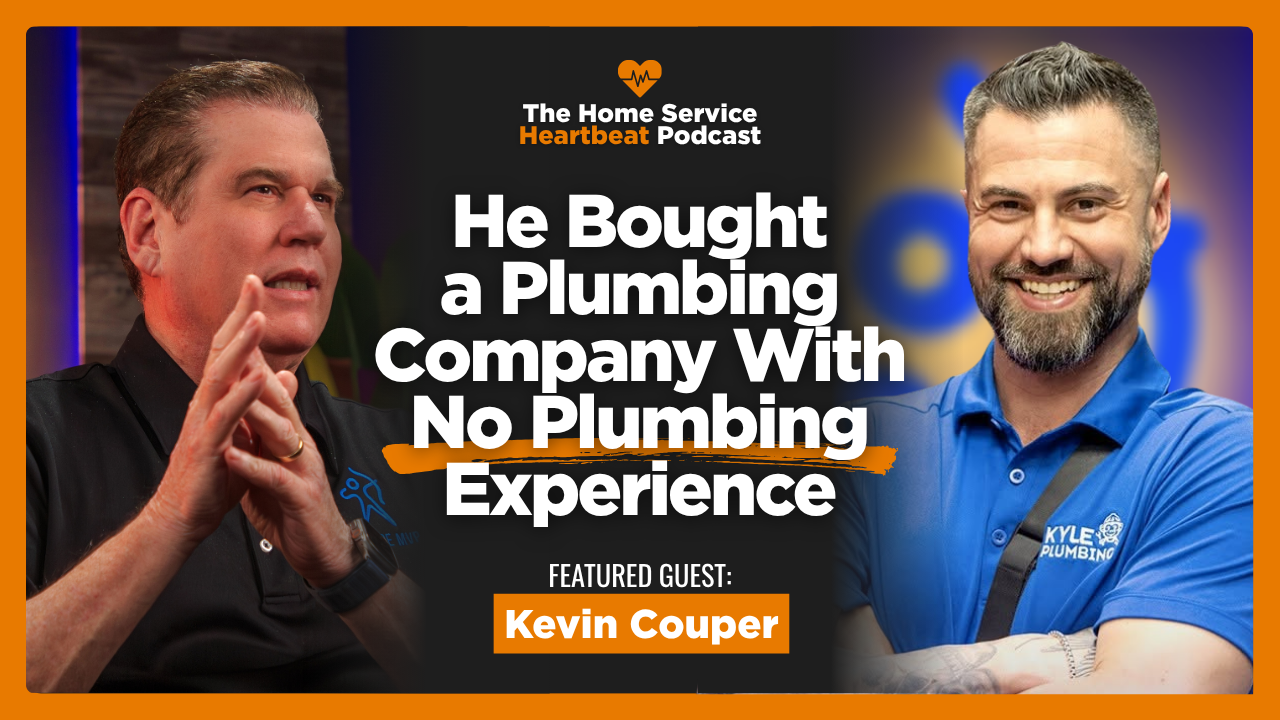
When Kevin Couper purchased Kyle Plumbing in Deerfield Beach, Florida, in June 2023, he wasn't a plumber.
He had spent 13 years in finance and wealth management. But he was an entrepreneur at heart, and after years of working with business owners, he decided he wanted to become one himself.
Three years later, the transformation at Kyle Plumbing is impressive.
The company's service division has quadrupled its revenue in just two years, while Kevin and his team have built a culture centered on training, communication, technology, customer service, and giving homeowners better choices.
Kevin recently joined Joe Crisara and the Home Service Heartbeat Podcast to talk about what he's learned while transforming a traditional plumbing company into a growing home service business.
And perhaps the most interesting part of the story isn't the revenue.
It's how they got there.
Kyle Plumbing by the Numbers
When Kevin purchased Kyle Plumbing:
- Approximately 70% of the company's revenue came from construction plumbing
- The service division generated approximately $1.3 million in annual revenue
- Service revenue doubled during Kevin's first year
- It doubled again during his second year
- Kyle Plumbing currently has 8 service technicians, 2 apprentices, and 2 installation technicians
- Technicians participate in approximately 75 minutes of required training every Tuesday
- Every employee receives a quarterly performance review
- Service technicians are scheduled for a maximum of 4 appointments per day
The result?
Kyle Plumbing's service business effectively quadrupled in two years.
But Kevin doesn't attribute that growth to one magic marketing campaign or sales technique.
He points instead to something much more fundamental: people, processes, training, communication, and culture.
Hear Kevin's Full Story
This article highlights some of our favorite takeaways from Joe Crisara's conversation with Kevin Couper on the Home Service Heartbeat Podcast. Watch the full episode to hear Kevin share how he's transforming Kyle Plumbing through people, training, technology and better customer choices.
How Do You Grow the Service Side of a Plumbing Business?
Growing a plumbing service business requires more than generating additional calls. You need trained technicians, repeatable processes, strong communication, and a customer experience that earns enough trust for homeowners to choose the solutions that are right for them.
Kevin inherited a business heavily dependent on construction plumbing.
Over approximately two years, he made the deliberate decision to wind down that side of the company and concentrate on service.
That meant implementing new software and processes, developing his people, and creating a more consistent experience for customers.
The financial results followed.
Service revenue doubled in the first year and doubled again in the second.
But as Joe pointed out during their conversation, revenue isn't simply a number on a financial statement. Increased service revenue can also be evidence that more customers are choosing to move forward with solutions because they understand their choices and trust the company providing them.
That's a principle we talk about frequently at Service MVP: higher revenue should be the result of creating greater value - not applying greater pressure.
How Do You Get Plumbing Technicians to Present More Options?
Train technicians to investigate thoroughly, communicate what they find, and give customers choices instead of simply completing the task originally requested. Presenting options isn't about upselling; it's about helping the customer understand the condition of their home and decide what they want to do.
Kevin describes the old service model at Kyle Plumbing as essentially "order taking."
A homeowner would call because of a toilet problem. The plumber would arrive, fix the toilet, collect payment, and leave.
Today, Kyle Plumbing technicians are trained to look at the bigger picture.
A plumbing system is interconnected. The obvious problem may not be the only problem, or even the underlying cause of the problem.
So technicians explain why they may want to inspect another component, such as the main valve, and educate the customer about anything else they discover.
The homeowner still gets to decide what happens next.
That distinction matters.
As Kevin explained during the podcast, being thorough isn't the same as upselling.
It's a philosophy closely aligned with Service MVP's approach to options-based service and Joe Crisara's Pure Motive Service system.
Instead of giving a customer an ultimatum, a service professional can present choices ranging from a more comprehensive, long-term solution to professional mid-range choices and more economical or temporary alternatives.
The technician's job isn't to decide what the customer should buy.
It's to help the customer understand "What should we do?" and give them enough information to make that decision confidently.
How Can Plumbers Present Options Without Making Customers Feel Like They're Being Upsold?
Start with education rather than persuasion. Explain what you found, why it matters, and what choices are available, then allow the customer to decide how far they want to go.
Kevin gave a simple example.
Imagine calling a plumber because of a toilet problem. While inspecting the system, the plumber notices another issue with a faucet that you didn't know existed.
Would you rather the plumber ignore it because you didn't specifically ask about the faucet?
Or would you want to know?
Kyle Plumbing's approach is to make the customer aware.
That doesn't mean the homeowner has to fix everything. It means the professional has fulfilled the responsibility to identify concerns and communicate them.
This is one of the fundamental shifts that happens when a technician moves from being a problem fixer to a service professional.
Great home service sales training isn't about teaching technicians to pressure people.
It's about teaching technically skilled people how to communicate value, explain solutions in everyday language, and help customers make informed decisions.
Should Plumbing Companies Hire for Skill or Attitude?
Kevin's philosophy is simple: hire for attitude and train for skill. Technical ability matters, but even the most talented plumber can damage a company's culture and customer experience with the wrong attitude.
Kyle Plumbing has built its field team around three distinct roles.
Its eight service technicians work independently in their trucks and typically have at least five years of plumbing experience.
Its two apprentices can enter the company with little or even no plumbing experience. They ride with different technicians, learning technical skills while also observing different ways of communicating with customers.
Finally, Kyle Plumbing has two installation technicians who are highly technically skilled but may not necessarily enjoy the customer communication side of the business.
Rather than forcing every employee into the same mold, Kevin tries to build around individual strengths.
That's a powerful home service leadership lesson.
Not every great technician needs to become the same kind of technician.
The better question is: Where can this person's strengths create the most value for the team and the customer?
How Often Should a Plumbing Company Train Its Technicians?
Kyle Plumbing trains its team every Tuesday morning for approximately 75 minutes. Kevin has found that consistent weekly training creates accountability and improvement without overwhelming the team.
The Tuesday training isn't limited to plumbing techniques.
The team discusses operational skills, software and iPad updates, success stories, customer communication, situations that didn't go as planned, and lessons employees can learn from one another.
Participation is required.
Kyle Plumbing supplements weekly training with quarterly individual reviews.
Those conversations help leadership understand:
- What are this employee's goals?
- Where are they strongest?
- Where do they need development?
- What kind of work do they enjoy?
- Where might they fit best as the company grows?
That ongoing approach is important because home service technician training isn't an event.
You don't train someone once and declare them trained.
Communication, technical ability, leadership, customer service, and options-based selling are skills that improve through repetition, coaching, feedback, and practice.
How Many Service Calls Should a Plumbing Technician Run Each Day?
Kyle Plumbing schedules a maximum of four appointments per service technician per day. The goal is to balance operational efficiency with giving technicians enough time to properly serve the customer in front of them.
Kyle Plumbing schedules four two-hour arrival windows:
9 AM to 11 AM / 11 AM to 1 PM / 1 PM to 3 PM / 3 PM to 5 PM
Kevin describes that as the company's current "sweet spot."
But the schedule isn't static.
Emergencies happen. Jobs take longer than expected. A technician finishes early. Another runs late.
Kyle Plumbing's customer service representatives and dispatchers continuously adjust the board based on what's actually happening in the field.
Kevin compared it to managing a chessboard.
And there's an important customer-service lesson behind the operational strategy:
Communicate before the customer has to ask.
If an emergency means another appointment needs to move, the office calls the customer and explains the situation.
Most customers understand.
What frustrates people isn't necessarily that something unexpected happened.
It's being left wondering where their plumber is.
How Important Is Communication in a Home Service Business?
Communication is part of the service—not something that happens around it. Kyle Plumbing intentionally over-communicates with both employees and customers because reliability and transparency build trust.
When a customer books an appointment, Kyle Plumbing sends a confirmation.
When the technician is dispatched, the customer receives another notification.
The company communicates when the technician arrives and follows up afterward with estimates, invoices, findings, and answers to questions.
If an estimate remains open, the customer service team may proactively reach out - not simply to "close the sale," but to make sure the customer received everything and doesn't have unanswered questions.
Internally, communication is just as constant.
The company uses Microsoft Teams, WhatsApp, email, text, and specialized channels to keep technicians, managers, warehouse staff, customer service representatives, and leadership connected throughout the day.
Sometimes exceptional customer service really is that simple:
Show up. Communicate. Do what you said you were going to do.
What Role Does Company Culture Play in Home Service Business Growth?
Culture ultimately reaches the customer. When employees feel supported, trained, accountable, and connected to their leadership, they're better equipped to create an exceptional customer experience.
For Kevin, culture starts at the top.
Despite buying a plumbing company without being a plumber himself, he didn't attempt to lead exclusively from behind a desk.
He went on ride-alongs.
He visited job sites.
He delivered materials.
He helped when the team needed another set of hands.
His managers do the same.
Kevin's philosophy is essentially to practice what you preach.
If leadership expects communication, respect, teamwork, hard work, and customer service from employees, leadership has to demonstrate those behaviors first.
And culture isn't something you create once.
It has to be maintained.
As the company grows, leaders have to understand that different employees communicate differently, respond to feedback differently, and require different approaches to development.
That's why effective home service leadership often looks a lot like coaching.
How Can Plumbing Companies Use AI Without Losing the Human Touch?
Use AI to make employees faster and communication better - not simply to eliminate human interaction. Kevin sees tremendous potential for AI behind the scenes while remaining cautious about replacing customer-facing employees before the technology can deliver the experience customers expect.
Kyle Plumbing is already looking for practical ways to integrate AI into its workflow.
One example involves estimates and invoices.
Plumbers aren't professional writers. Asking a technician to stand in someone's driveway and type several polished paragraphs onto an iPad isn't necessarily the best use of that technician's time.
Kevin's team is working on ways for technicians to speak their findings and have AI help turn that information into a concise, professional summary for the customer.
That's where Kevin believes AI can make an immediate difference:
Make the professional more effective rather than making the professional disappear.
AI can also help research unusual plumbing situations, find information more quickly, and reduce administrative friction behind the scenes.
But Kevin isn't ready to hand every customer interaction over to an AI dispatcher.
For now, he believes customers still value talking to another human being.
Technology should improve the customer experience—not become a barrier to it.
People Over Pipes
Toward the end of their conversation, Joe noticed something interesting.
After more than 30 minutes talking about a plumbing company, very little of the conversation was actually about plumbing.
It was about people.
Kevin said one of the things that motivates him most is seeing employees thrive.
Kyle Plumbing has grown into what he describes as roughly a 20-person family. He wants employees to have a good place to work, opportunities to develop, and the ability to make a good living.
Happy, competent employees create better experiences for customers.
Those customers help create a healthier business.
And that healthier business creates more opportunities for employees.
Joe summed up Kevin's philosophy in three words:
People over pipes.
Kevin agreed.
That might also be one of the biggest lessons behind Kyle Plumbing's growth.
What Can Other Home Service Business Owners Learn From Kyle Plumbing?
Kyle Plumbing's story demonstrates that sustainable service business growth isn't built around one sales trick.
It's a system.
Develop good people. Train consistently. Diagnose thoroughly. Communicate clearly. Give customers choices. Use technology intelligently. Hold people accountable. And create a culture where employees actually want to succeed.
Do those things consistently and the financial numbers can become the outcome rather than the objective.
For Kevin Couper and Kyle Plumbing, that approach helped turn approximately $1.3 million in service revenue into a service operation that quadrupled in two years.
And they're still building.
Watch Kevin Couper on the Home Service Heartbeat Podcast
Hear the complete conversation between Kevin Couper of Kyle Plumbing and Joe Crisara of Service MVP on the Home Service Heartbeat Podcast.
▶️ Watch the full MVP Club episode on YouTube
If you're in Broward or Palm Beach County and want to learn more about Kevin's team, visit Kyle Plumbing.
Want to Build These Skills Inside Your Own Home Service Business?
At Service MVP, we help home service owners, leaders, office teams, and field professionals develop the communication, leadership, customer service, and options-based selling skills that create better experiences for customers, and stronger businesses.
Our training is built around Joe Crisara's Pure Motive Service philosophy: help the customer understand what's possible, provide meaningful choices, and allow them to select the solution that's right for them.
Learn more about Service MVP coaching and training.
Have a Home Service Story Worth Sharing?
Home Service Heartbeat spotlights the owners, leaders and teams behind the home service industry. If you've built something you're proud of, learned lessons other contractors could benefit from, or have a story worth telling, we'd love to hear it.
