
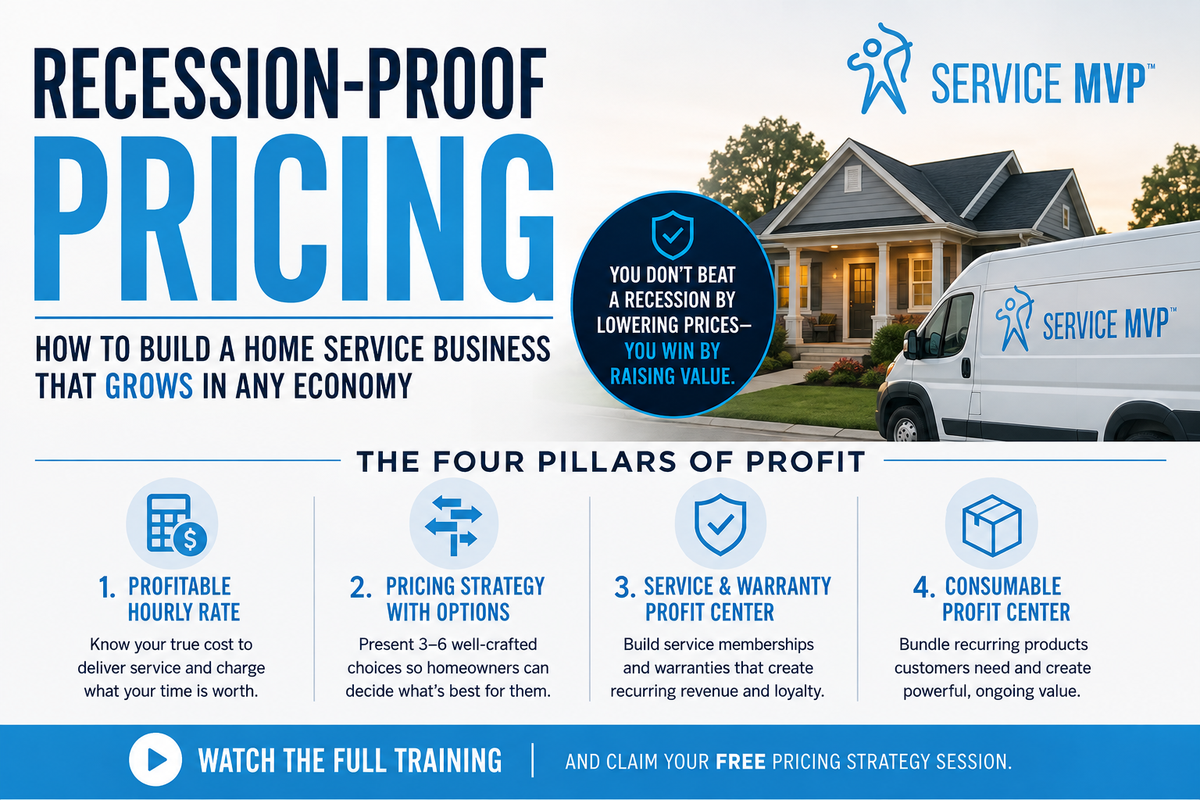
Recession-Proof Pricing: How to Build a Home Service Business That Grows in Any Economy
Recession-Proof Pricing: How to Build a Home Service Business That Grows in Any Economy
By Joe Crisara, Author of What Should We Do? and Co-Founder of Service MVP
When the economy tightens, it's natural for home service contractors to get nervous.
Customers become more cautious. Leads may slow down. Equipment and material costs continue changing. Payroll, insurance, vehicles, fuel, and overhead don't suddenly get cheaper just because homeowners are watching their spending.
And that's when some contractors make a dangerous decision:
They lower their prices.
The thinking seems logical. If customers have less money to spend, make your services cheaper and you'll win more work.
But there's a problem.
Your costs haven't disappeared.
Lowering your prices without lowering the actual cost of delivering your service simply means you've volunteered to absorb the difference.
At Service MVP, we teach contractors a different approach:
You don't build a recession-proof home service business by lowering your price. You build one by increasing your value and protecting your profit.
That requires courage.
In fact, there's one phrase I've repeated to contractors for years:
Profit takes courage.
It takes courage to know what you actually need to charge. It takes courage to stop copying your competitors' prices. It takes courage to give homeowners multiple choices instead of assuming what they can afford.
And it takes courage to build a business designed to remain healthy in good economies and difficult ones.
A big part of that strategy comes down to what we call the Four Pillars of Profit.
Pillar 1: Know Your Profitable Hourly Rate
Ask a room full of contractors how they calculated their hourly rate and you'll hear all kinds of answers.
Some looked at what their competitors charge.
Some took their technician's hourly wage and multiplied it.
Some picked a number that "felt about right."
Others inherited a pricebook that nobody has seriously reviewed in years.
None of those approaches tells you what your company actually needs to produce per hour to remain profitable.
Your profitable hourly rate has to account for far more than the technician's wage.
Think about everything required to put a trained service professional in a customer's driveway:
- Wages and benefits
- Payroll taxes
- Non-billable and unapplied labor
- Drive time
- Training and meetings
- Vacation and PTO
- Trucks
- Fuel
- Vehicle maintenance
- Insurance
- Tools
- Inventory
- Office staff
- Dispatch
- Management
- Software
- Facilities
- Marketing
- Callbacks and warranty work
- And all the other overhead required to operate the company
Then, after all of that is paid, the business still needs to produce a profit.
That's why simply saying, "My technician costs me $40 an hour, so I'll charge $150" doesn't tell you very much.
The real question is:
How much revenue does this company need to generate for each productive hour it has available?
For some companies, the answer can be several hundred dollars per hour. For others, depending on their costs, utilization, overhead, and profit goals, it can be considerably higher.
There's no universal magic number.
There is a right number for your business.
And you can't build a truly profitable pricebook until you know it.
Busy Doesn't Always Mean Profitable
This is one of the hardest lessons in the home service business.
You can have trucks running everywhere.
Technicians working overtime.
Phones ringing.
A packed schedule.
Millions of dollars in annual revenue.
And still have a profitability problem.
Why?
Because revenue and profit aren't the same thing.
If the price of the work doesn't adequately cover the true cost of producing it, doing more of that work doesn't necessarily solve the problem.
Sometimes it makes it bigger.
That's why I want contractors to stop asking:
"What will customers let us charge?"
and start with:
"What does it actually cost us to deliver exceptional service and operate a healthy company?"
Then we can talk about how to create enough value to justify that price.
That's where the second pillar comes in.
Pillar 2: Build a Pricing Strategy Around Choices
Once you know what your time is worth, the next question is:
How are you presenting solutions to homeowners?
Too many service calls still end with one diagnosis and one price.
"Here's what's wrong. Here's what it'll cost. Do you want to do it?"
That forces the homeowner into a binary decision:
Yes or no.
But homeowners don't all have the same priorities.
One person may want the most comprehensive solution possible.
Another may care most about reliability.
Someone else may need to solve the immediate problem today and address other issues later.
That's why we teach technicians to create multiple appropriate options whenever the situation allows.
At Service MVP, we call this the Pure Motive Option Method.
Instead of deciding for the customer, the technician identifies what they've observed, discusses the customer's priorities, and creates meaningful choices.
Those choices may include premium, mid-range, and more economical approaches.
The technician's job isn't to decide which one the customer should buy.
The technician's job is to make sure the homeowner understands the choices well enough to decide for themselves.
I've written more about this philosophy in Stop Giving Homeowners One Price: Why Service Technicians Should Present Options.
Giving customers choices isn't about pressure.
It's about control - the customer's control.
And that's especially important when economic conditions become uncertain.
Don't Assume What Your Customer Can Afford
During a recession or economic slowdown, it's easy for technicians and business owners to start making financial decisions for their customers.
They're probably going to want the cheapest option.
They won't spend that much right now.
I shouldn't even show them this.
That's not our decision to make.
We don't know every homeowner's finances, priorities, plans, or circumstances.
One homeowner may want the least expensive repair.
Another may have been waiting for an opportunity to replace the system.
Another may value a longer warranty.
Another may care most about indoor air quality, energy efficiency, safety, convenience, or preventing future breakdowns.
Our job is to educate. Their job is to choose.
That philosophy becomes even more important when the economy gets difficult.
Pillar 3: Turn Service and Warranties Into a Profit Center
The third pillar is about looking beyond today's transaction.
A homeowner doesn't stop being a customer when today's repair is complete.
Their equipment still needs maintenance.
Parts will eventually wear.
Systems will age.
And the homeowner will need someone they trust when the next problem occurs.
That's why properly structured service memberships and warranties can become such an important part of a resilient home service business.
A great membership can provide customers with things they genuinely value:
Priority service. Preventive maintenance. Longer-term protection. Convenience. Peace of mind.
And for the contractor, memberships can create something equally valuable:
an ongoing customer relationship.
That's an important distinction.
If your business has to find a completely new customer every time it needs revenue, you're constantly paying to recreate relationships you've already earned.
A strong service membership gives customers a reason to continue doing business with you.
And recurring customer relationships can make a company considerably more resilient when new-lead volume becomes unpredictable.
Pillar 4: Find the Recurring Value in Consumables
This is one of the most overlooked opportunities in home service.
Think about products customers will need repeatedly anyway.
Depending on your trade, that might include:
Air filters. Water filters. Water-softener salt. Maintenance products. Replacement components. Surge protection or other regularly needed items and services.
Contractors often treat these as tiny transactions that aren't worth much attention.
But think about them differently.
Instead of asking:
"Can we sell this customer a filter today?"
ask:
"Is there a convenient way we can take care of this need for the customer for the next several years?"
Now you're no longer thinking about a $20, $50, or $100 transaction.
You're thinking about the lifetime value of the relationship.
Depending on the product and your operating model, some consumables can even be fulfilled without loading additional inventory onto every truck.
The individual transaction may be small.
Across hundreds or thousands of customers - and multiple years - the opportunity can become substantial.
More importantly, you're making it easier for the customer to continue taking care of their home.
That's recurring value.
How the Four Pillars Work Together
This is where the recession-proofing strategy becomes clearer.
These aren't four unrelated tactics.
They support each other.
Your profitable hourly rate protects your margin.
You know what the company needs to earn instead of guessing.
Your pricing strategy gives homeowners choices.
You're not depending on every customer saying yes to one solution at one price.
Service memberships create longer-term relationships.
You're not starting from zero every month looking for an entirely new group of customers.
Consumables create additional recurring value.
You're finding more ways to serve customers you've already earned.
Put those pieces together and you start creating a fundamentally different home service business.
One that's less dependent on:
More leads. More trucks. More calls. More volume.
And more focused on:
Better margins. Better choices. Better customer relationships. More value from the opportunities you already have.
That's a much stronger position when economic conditions become uncertain.
Recession-Proof Doesn't Mean Recession-Proof From Reality
No business is immune to the economy.
That's not what I'm suggesting.
Homeowners can postpone purchases.
Interest rates can change.
Lead volume can decline.
Material prices can increase.
Fuel can get expensive.
Labor costs can rise.
You can't control all of that.
What you can control is how your business is built to respond.
Do you know your numbers?
Does your pricebook reflect your current costs?
Are you protecting your margins?
Are your technicians identifying all the legitimate opportunities to help customers?
Are you giving homeowners meaningful choices?
Are you developing recurring customer relationships?
Are you creating revenue from customers you've already spent money to acquire?
Those are things you can influence.
And that's why I believe profit takes courage.
Sometimes the courageous decision isn't lowering your price because everybody else is nervous.
It's knowing what you're worth, creating more value, and building a business strong enough to continue taking care of customers, employees, and their families regardless of what the economy does next.
Want to See the Four Pillars of Profit in Action?
If you're serious about building a home service business that can remain profitable through changing economic conditions, watch the full training.
I walk through the pricing strategy, the numbers behind it, and practical ways contractors can begin applying the Four Pillars of Profit in their businesses.
Watch the full Recession-Proof Pricing training and start looking at your pricing differently.
And if you'd like help applying these strategies throughout your company, learn more about Service MVP Coach Guided Training.
Because the goal isn't simply to charge more.
The goal is to build a more valuable, more profitable, and more resilient home service business.
