
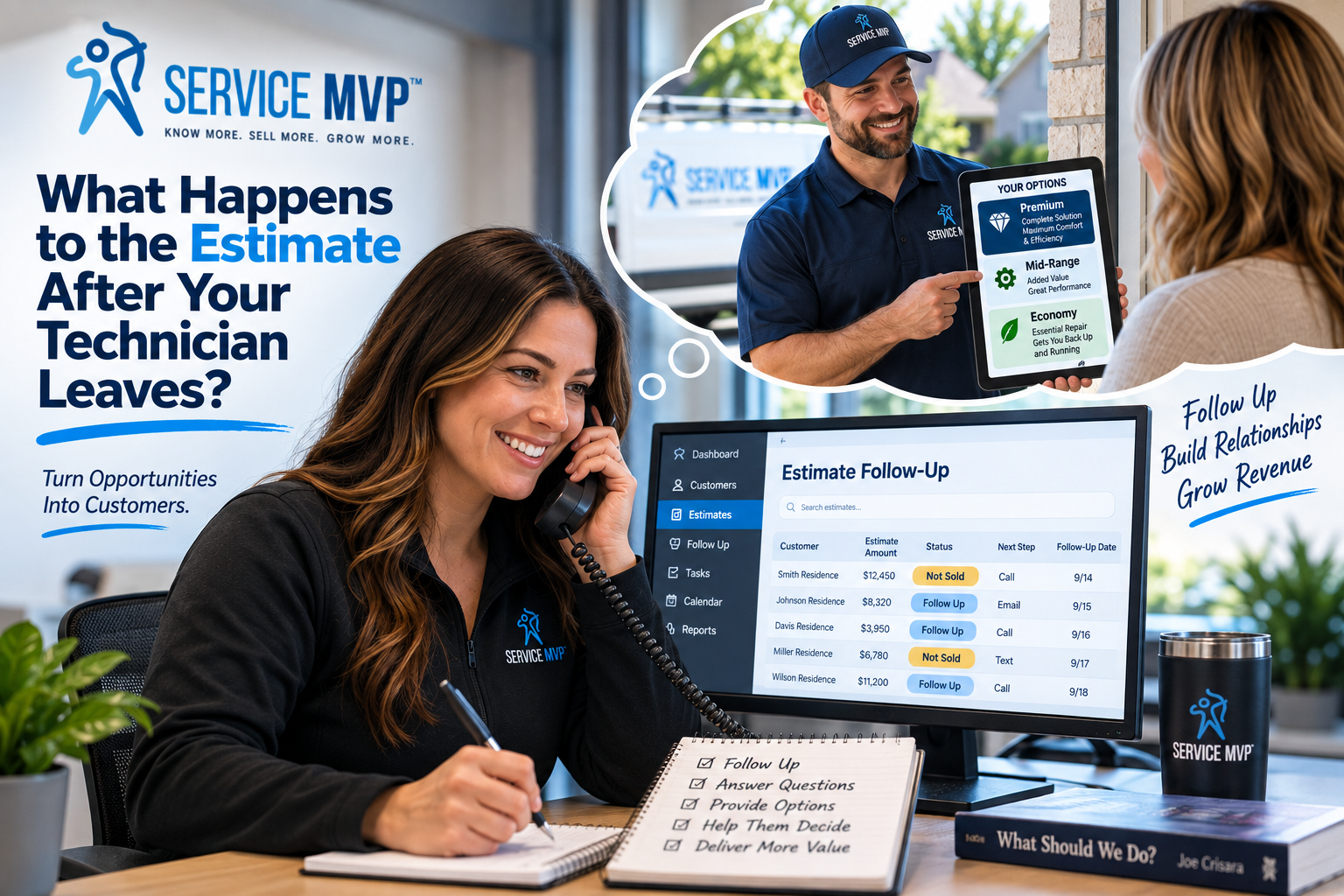
What Happens to the Estimate After Your Technician Leaves?
What Happens to the Estimate After Your Technician Leaves?
By Joe Crisara, Author of What Should We Do? and Co-Founder of Service MVP
Your technician did everything right.
They listened to the homeowner.
They diagnosed the system thoroughly.
They identified legitimate opportunities.
They built meaningful options.
They explained the differences.
And the homeowner said:
“We need to think about it.”
The technician leaves.
The garage door closes.
And then what?
For a surprising number of home service companies, the answer is:
Nothing.
The estimate sits inside the software.
Maybe an automated email goes out.
Maybe somebody remembers to call.
Maybe the technician follows up if they have time.
Maybe the office assumes the technician owns it.
Maybe the technician assumes the office owns it.
And a perfectly good opportunity slowly disappears.
Here's the question every home service company should be able to answer:
Who owns the opportunity after the technician leaves?
If the answer isn't immediately clear, you may have a lead recovery problem.
“Not Today” Does Not Always Mean “No”
Homeowners don't move forward with work for all kinds of reasons.
Sometimes price really is the issue.
But sometimes they want to speak with a spouse.
They need to look at their finances.
They want to think about which option makes the most sense.
The project isn't urgent yet.
They're leaving for vacation.
They need financing.
They simply weren't prepared to make a major decision that afternoon.
And yes, sometimes they don't want to do the work at all.
That's okay.
The problem isn't that every estimate doesn't turn into a sale.
The problem is when we never find out which one it was.
There is a major difference between a homeowner saying:
“No, we've decided not to move forward.”
and an estimate sitting untouched for six months because nobody followed up.
One is a decision.
The other is an abandoned opportunity.
You Already Paid to Create That Opportunity
This is especially important when you consider the economics of a service call.
Your company may have paid for:
Marketing.
A CSR to answer the phone.
Dispatch.
The technician's wages and benefits.
The service vehicle.
Fuel.
Insurance.
Training.
Tools.
Software.
Inventory.
And all the overhead required to get a trained professional into that home.
Then the technician spent time diagnosing the situation and discovering legitimate needs.
You've already invested in creating that opportunity.
That's why I believe one of the most expensive mistakes a home service company can make is constantly chasing new leads while ignoring opportunities it has already paid to create.
We talked about this in The Most Expensive Service Call Is the One You Already Paid For.
Once that article is live, this is exactly where I'd link it.
An Unsold Estimate Is Not a Lost Lead Yet
I think the language we use matters.
Companies often refer to anything that didn't sell on the service call as lost revenue.
But has it actually been lost?
Maybe not.
I'd rather think of it as an unresolved opportunity.
The homeowner has a legitimate need.
Your company identified it.
You've provided possible solutions.
The homeowner simply hasn't made a final decision yet.
That opportunity should remain active until there is a clear conclusion:
Yes.
No.
Or:
Not now - with a specific next step.
That's very different from allowing the estimate to disappear into your field-service software.
Someone Has to Own the Follow-Up
Here's where the process usually breaks.
Who follows up?
The technician?
CSR?
Comfort advisor?
Salesperson?
Outbound caller?
Customer-care team?
Manager?
There isn't one universal answer.
Different companies can structure this differently.
But there does need to be an answer.
If everybody is responsible, there's a good chance nobody is responsible.
A strong lead-recovery process clearly defines:
Who owns the opportunity.
When the first follow-up happens.
How often follow-up occurs.
Which communication methods are used.
What gets documented.
When the opportunity is considered closed.
Your software can help manage the process.
But software doesn't create accountability.
People and process do.
Follow-Up Shouldn't Feel Like Chasing
This is where some technicians and office employees become uncomfortable.
They don't want to bother the customer.
I understand that.
Nobody wants to become the company calling every afternoon asking:
“Have you decided yet?”
That's not what good follow-up looks like.
Follow-up should be helpful.
For example:
“When we were there Tuesday, you were considering the repair and the longer-term option. I wanted to see if any questions came up after you had a chance to look everything over.”
That's different from:
“Are you ready to buy?”
One continues the service conversation.
The other creates pressure.
The purpose of follow-up is to help the homeowner reach a decision—not wear them down until they surrender.
Your Technician Should Create the Next Step Before Leaving
The best follow-up may actually begin before the technician leaves the home.
If the homeowner says:
“I need to talk with my husband tonight.”
Instead of:
“Okay, give us a call.”
the technician could say:
“Absolutely. Would it be helpful if we checked back with you tomorrow afternoon after you've had a chance to talk?”
Now there's an agreed-upon next step.
The homeowner knows you're calling.
Your team knows when to follow up.
And the opportunity doesn't depend on someone remembering it later.
Whenever possible, don't leave the next step vague.
Put it on the calendar.
“Call Me If You Need Anything” Isn't a Follow-Up Strategy
This is one of the most common endings to an unsold estimate:
“Here's my card. Call me if you have any questions.”
That's polite.
But it transfers the entire responsibility for the next step to the homeowner.
Think about their life.
Kids.
Work.
Appointments.
Bills.
Travel.
Dinner.
A hundred other things demanding their attention.
That HVAC estimate that was extremely important at 2:30 Tuesday afternoon may be buried under everything else by Friday.
Professional follow-up doesn't mean pestering them.
It means we don't make the customer responsible for remembering us.
Your Follow-Up Cadence Should Match the Opportunity
Not every estimate deserves exactly the same follow-up process.
A homeowner considering a major system replacement may need a different cadence than someone who deferred a small plumbing repair.
Urgency matters.
Safety matters.
Project size matters.
Customer timing matters.
What the homeowner told you matters.
That's why I wouldn't build a follow-up system that blindly sends the exact same message to everyone on days 1, 3, 7, 14 and 30.
Automation can be useful.
But the best follow-up still feels connected to the actual conversation that happened in the home.
Document Why the Homeowner Didn't Move Forward
Here's another enormous coaching opportunity companies often miss.
Why didn't the customer choose an option?
Do you know?
Was it:
Price?
Timing?
Financing?
Trust?
Confusion?
A spouse who wasn't present?
They wanted another estimate?
The options didn't address what mattered to them?
The technician never clearly asked which option they preferred?
Or did the homeowner simply decide the work wasn't important enough right now?
These are very different situations.
If everything gets labeled:
“Estimate not sold”
leadership learns almost nothing.
But if you consistently capture the reason an opportunity remains unresolved, patterns begin to appear.
And patterns give leaders something to coach.
Lead Recovery Is Also a Coaching Tool
Suppose one technician has significantly more unresolved estimates than everyone else.
Don't immediately tell them:
“You need to close more.”
Look at the process.
Are they identifying the right opportunities?
Are they building enough choices?
Are they explaining the differences clearly?
Are they connecting solutions to what the homeowner said matters?
Are they comfortable discussing financing?
Do they ask the homeowner which option they'd like?
Do they understand the concern when the customer hesitates?
This is why we've been building these topics in sequence.
First:
Did the technician find the opportunity?
Then:
Did they build meaningful options?
Then:
Did the homeowner make a decision?
And if not:
What happens next?
Revenue is the outcome of an entire process.
Looking only at the final number makes it much harder to see where the process needs improvement.
Some “Lost” Opportunities Were Never Properly Presented
This is important.
Lead recovery shouldn't become a system designed to compensate for a weak service call.
If the technician rushed the diagnosis, didn't understand the homeowner, presented one confusing price and left, having an outbound caller chase the estimate afterward doesn't fix the underlying problem.
The strongest recovery system starts with a strong field experience.
We've talked about why technicians need to present multiple meaningful options rather than one take-it-or-leave-it price.
And we've also discussed what happens when technicians struggle to communicate the value behind the pricebook.
Lead recovery should support a great process.
It shouldn't replace one.
Track How Much Opportunity Is Sitting in Your Business
Here's a number I'd want every home service owner to know:
How much legitimate unsold opportunity is currently sitting in our system?
Not just how many estimates.
How much potential work?
Then I'd want to know:
How old are those opportunities?
Who owns them?
When were they last contacted?
Why didn't the homeowner move forward?
What is the next scheduled action?
How much have we recovered?
How much has reached a definitive no?
Those numbers can reveal something remarkable.
A company may think it needs another $100,000 in new leads.
Meanwhile, there may already be hundreds of thousands of dollars in legitimate unresolved work sitting inside its existing customer base.
That's worth knowing.
Don't Confuse Recovery Rate With Pressure
Once companies start measuring lead recovery, there's a danger.
Management creates a recovery goal.
Then the goal becomes a quota.
Then the quota creates pressure.
And suddenly the customer who said no receives eight phone calls because somebody needs to hit a number.
That's not the goal.
Measure recovery so you can understand your process.
Don't use it as permission to ignore what the customer wants.
Pure Motive still applies after the technician leaves.
Help the customer reach the right decision - even when that decision is no.
A Clear “No” Is Better Than an Eternal “Maybe”
This may sound strange coming from someone teaching lead recovery, but I actually want your team to get more clear no's.
Why?
Because a clear no is information.
The customer has made a decision.
You can document why.
You can respect it.
Your team can stop spending time on an opportunity that isn't moving forward.
What I don't want is thousands of estimates sitting in a database marked:
Open.
Nobody knows why.
Nobody knows who owns them.
Nobody knows whether the customer was contacted.
Nobody knows whether the need still exists.
Nobody knows whether the homeowner bought from somebody else.
That's not a pipeline.
That's a graveyard.
The Goal Is a Clear Conclusion
Every legitimate opportunity your company discovers should eventually reach a conclusion.
Yes - the homeowner chooses a solution.
No - the homeowner decides not to move forward.
Or:
Later - with a defined reason and a specific next action.
That's what a professional lead-recovery process creates.
Not pressure.
Not endless chasing.
Clarity.
Because the service experience doesn't necessarily end when the truck leaves the driveway.
Sometimes that's simply when the next part begins.
How Much Revenue Is Sitting in Your Unsold Opportunities?
If you don't know the answer, that's worth investigating.
At Service MVP, we help home service companies build the systems behind the service call-not just what technicians say in the home, but the leadership, accountability, measurement and follow-up processes that turn good intentions into consistent execution.
If your team is generating estimates but nobody clearly owns what happens next, lead recovery may be one of the biggest opportunities already sitting inside your business.
