By Joe Crisara, Author of What Should We Do? and Co-Founder of Service MVP
Short answer
What should service managers practice with their team every Friday?
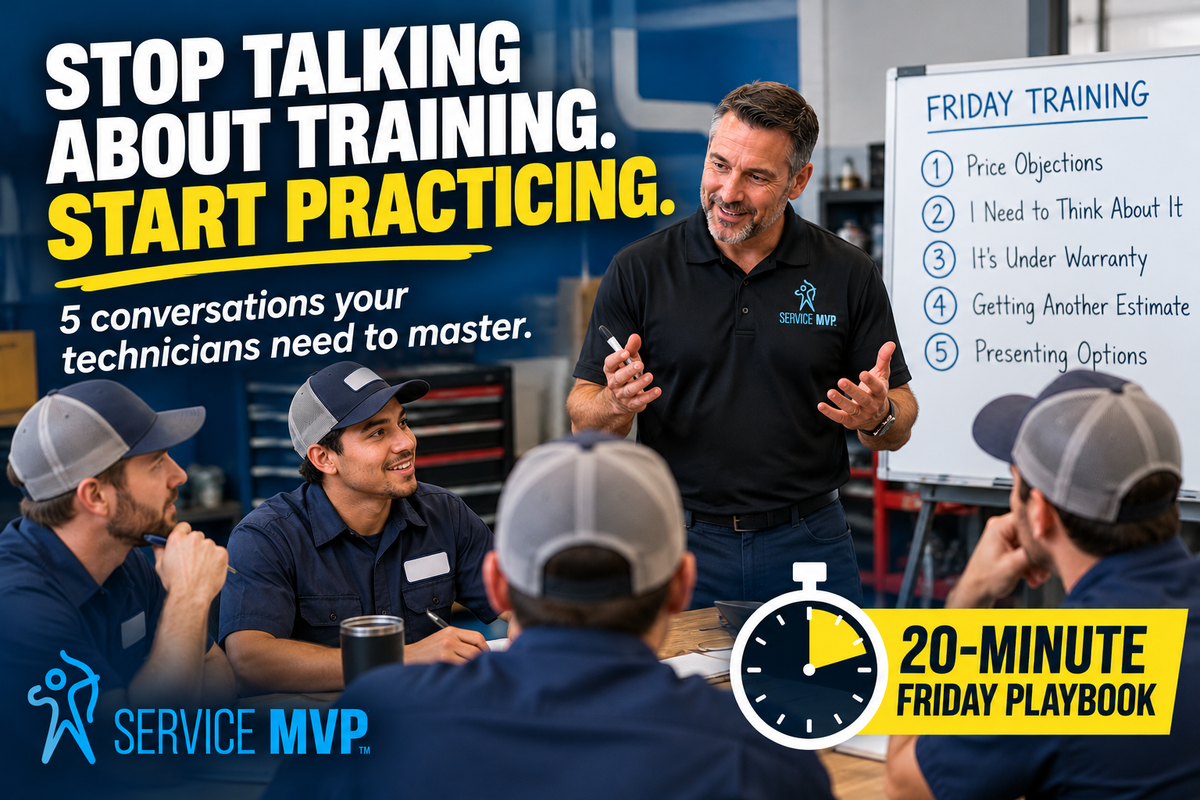
Five Customer Conversations Every Service Manager Should Practice: “Your Price Is Too High.” “I Need to Think About It.” “It's Under Warranty.” “We're Going to Get Another Estimate.” Presenting Premium, Mid-Range, and Economy Options.
Let me ask you a question.
When was the last time you had a service meeting where your technicians actually practiced something?
Not listened to something.
Not watched another training video.
Not sat through another discussion about why sales are down or why customers aren't buying.
I mean actually stood up, practiced a conversation, made a mistake, received some coaching, and tried it again.
If you're like a lot of service managers, it probably doesn't happen nearly enough.
And here's what I want you to understand:
Your weekly service meeting might be one of the most valuable training opportunities in your entire business. But only if your technicians are doing more than listening.
I've seen companies invest thousands of dollars in training, send technicians to classes, and purchase all kinds of educational programs.
Then they bring everyone back to the shop and go right back to business as usual.
The technicians know what they should be doing.
But nobody's making sure they can actually do it.
So today, I want to show you how to turn your weekly service meeting into something that creates real improvement.
And you don't need two hours to do it.
Why Most Service Meetings Don't Improve Technician Performance
Think about what happens during a typical service meeting.
The manager talks about the numbers.
Maybe somebody brings up a customer complaint.
The team discusses callbacks, scheduling problems, or why the average ticket is down.
Then the manager reminds everyone to follow the process, present options, and communicate better with customers.
Sound familiar?
Now, there's nothing wrong with discussing those things.
But here's the problem.
Telling somebody to improve isn't the same as teaching them how to improve.
Imagine a technician struggling with price objections.
The manager says:
“Guys, you've got to stop discounting. You need to explain the value.”
Okay.
But what does that technician actually say when a homeowner looks at a $4,000 estimate and responds:
“Are you kidding me? That's way too expensive!”
If they don't know how to handle that moment, another reminder isn't going to help.
They need to practice the conversation.
And that's exactly what I want service managers to start doing.
Start With the Problems Your Technicians Are Actually Having
Here's the first thing I'd recommend.
Don't choose your training topic because it's the next chapter in a manual.
Choose it because it's something your technicians need help with right now.
Look at what happened during the week.
Did several technicians struggle with customers asking for discounts?
Did somebody lose an opportunity because they couldn't explain the difference between their repair options?
Did a homeowner complain that they didn't understand the estimate?
Did a technician have trouble explaining why a home warranty didn't cover the entire repair?
Those are training opportunities.
And the great thing is, you don't have to guess what your team needs.
Your service calls are telling you.
Every recurring problem in your business is an opportunity to identify a skill that needs improvement.
Instead of saying, “We need to sell more,” ask:
“What specifically are our technicians struggling to do?”
That's where your next practice session should begin.
Five Customer Conversations Every Service Manager Should Practice
If you're wondering where to start, here are five situations I think every residential service team should be comfortable handling.
1. “Your Price Is Too High.”
This is one of the most common challenges in home service sales.
A technician presents an estimate.
The homeowner reacts to the price.
And suddenly the technician becomes defensive.
Or they start explaining the company's overhead.
Or they offer a discount before understanding the customer's concern.
Here's what I want managers to practice.
Have one technician play the homeowner and say:
“Wow. I wasn't expecting it to cost that much.”
Then have the other technician practice acknowledging the concern, asking an appropriate question, and helping the homeowner understand the value of the recommended solution.
Don't make the goal winning an argument.
Make the goal understanding the concern and responding professionally.
2. “I Need to Think About It.”
This is another situation where technicians often stop the conversation too soon.
The homeowner says they need to think about it.
The technician says, “Okay, give us a call.”
And that's the end.
But what if the homeowner is confused about the options?
What if they don't understand the difference between the repair and replacement recommendations?
What if they need to discuss the investment with another family member?
Practice asking a respectful follow-up question.
For example:
“Of course. It's an important decision. Can I ask what part you'd like more time to think through? I want to make sure I've explained everything clearly.”
Then practice listening to the answer.
Sometimes the best thing a technician can do is stop talking long enough to understand the customer.
3. “It's Under Warranty.”
We recently covered this in our MVP Club training.
Some technicians hear the word warranty and immediately assume there's no opportunity.
But a warranty doesn't eliminate the need for a proper diagnosis.
It doesn't mean every issue is covered.
And it doesn't mean the homeowner shouldn't understand their choices.
Have your team practice explaining three different situations: a fully covered repair, a partially covered repair, and a repair that's not covered.
The technician should learn to explain the findings, verify the coverage, and present appropriate options without becoming defensive.
This is especially valuable for HVAC, plumbing, electrical, and appliance service companies.
4. “We're Going to Get Another Estimate.”
Here's another great role-play.
The homeowner says:
“We're going to get a couple more estimates before we decide.”
What does your technician do?
Do they immediately discount?
Do they criticize competitors?
Or do they ask whether the homeowner has the information needed to compare the different solutions?
Practice a response like:
“Absolutely. It's important to feel comfortable with your decision. Before I go, would it help if we reviewed exactly what's included in each of these options so you know what to compare?”
That's not pressure.
That's service.
And it's an opportunity to make sure the homeowner understands what they're buying.
5. Presenting Premium, Mid-Range, and Economy Options
This is one of my favorites.
Give your technician a realistic service scenario.
Maybe it's a water heater with multiple concerns.
Maybe it's an aging air conditioning system.
Maybe it's a garage door that needs repair.
Then ask them to explain three legitimate options.
Not just read three prices.
Explain what each solution accomplishes.
Explain the differences.
Explain any limitations.
And help the homeowner understand which choice might best fit their needs.
You can use tools like OptionBuilder AI to organize the estimates, but the technician still needs the communication skills to explain them.
The estimate doesn't sell itself. The homeowner needs to understand it.
Here's a 20-Minute Friday Training Meeting You Can Use Tomorrow
Now, I know what some of you are thinking.
“Joe, that sounds great, but we don't have time for another long meeting.”
I understand.
So let's make this simple.
You can accomplish a lot in twenty focused minutes.
Minutes 1-3: Identify One Problem
Choose one situation your technicians struggled with during the week.
For example:
“Several customers told us our prices were too high.”
Explain why you're practicing that conversation.
Keep it specific.
Minutes 4-6: Demonstrate the Skill
Have the manager or a skilled coach demonstrate an appropriate response.
Let the technicians hear the words, tone, and questions.
Show them what a good conversation sounds like.
Minutes 7-10: Repeat It Back
Ask technicians to repeat the response.
This is important.
Don't assume they learned it just because they heard it.
Have them actually say it.
Correct misunderstandings before moving on.
Minutes 11-16: Role-Play
Pair technicians together.
One plays the homeowner.
The other plays the service professional.
Let them practice the conversation.
Then switch roles.
Keep the scenario realistic.
And don't make the homeowner unnecessarily hostile just to make the exercise difficult.
Minutes 17-19: Coach and Repeat
Give each technician one useful piece of feedback.
Then let them try again.
Don't overwhelm somebody with ten things they did wrong.
Focus on one improvement.
Minute 20: Make a Field Commitment
Before ending the meeting, ask:
“Where are you going to use this skill on your next service call?”
Have each technician identify an appropriate opportunity to practice it in the field.
Then follow up.
Because the purpose of the meeting isn't to become good at role-playing.
The purpose is to become better at serving customers.
The Most Important Part Happens After Friday's Meeting
Here's where a lot of companies fall short.
They hold a good training session.
Everybody participates.
The manager feels great.
And then nobody talks about the lesson again.
That's a missed opportunity.
The next week, ask technicians how they used the skill.
What happened?
What worked?
Where did they struggle?
What would they do differently?
You can use appropriate call reviews, ride-alongs, or other observations to help evaluate progress.
And when somebody improves, recognize it.
Not just because they made a sale.
Recognize the behavior.
Maybe they asked a better question.
Maybe they explained the customer's options more clearly.
Maybe they handled a difficult conversation without becoming defensive.
Those are the skills that eventually improve performance.
If you want a deeper look at what managers should do after training, read What Should Service Managers Do in the First 30 Days After Technician Training?.
Don't Turn Role-Playing Into an Embarrassing Experience
Let me tell you something about training adults.
Nobody enjoys feeling foolish in front of their coworkers.
Especially experienced technicians who've spent years developing their technical skills.
So don't turn your training meeting into an opportunity to embarrass somebody.
Don't mock their mistakes.
Don't make the customer role so unrealistic that nobody could possibly succeed.
And don't compare your struggling technician to your top performer.
Instead, create an environment where everybody understands that practice is how we improve.
Start with simple scenarios.
Let technicians use notes when they're learning.
Give specific feedback.
And celebrate progress.
I'd much rather see a technician stumble during a practice session than struggle alone in a customer's home.
That's why we practice.
Managers Need to Practice, Too
Here's something I want business owners to think about.
If you're asking your technicians to practice, are your managers willing to demonstrate the skills themselves?
Can your service manager handle the same price objection they're asking technicians to handle?
Can they explain Premium, Mid-Range, and Economy options?
Can they demonstrate how to ask better discovery questions?
Because if the manager can't show the team what good looks like, how are they going to coach it?
Leadership isn't just about holding people accountable.
It's about helping them develop the ability to succeed.
And sometimes that means the manager needs training and practice, too.
Why We Practice These Conversations in the MVP Club
This is one of the reasons we created the MVP Club.
Every Friday, we work through real situations that service professionals encounter in customers' homes.
We teach a specific lesson.
We discuss how it applies in the field.
And we give participants opportunities to ask questions, practice, and improve.
Sometimes we're discussing price objections.
Sometimes it's warranty calls.
Sometimes it's how to handle unusual customer situations.
The subject may change, but the goal stays the same.
We want service professionals to leave with something they can actually use.
Not just another piece of information.
A skill.
And I want managers to take those lessons back to their own teams and continue practicing them.
Because a single training session shouldn't be the end of learning.
It should be the beginning of improvement.
Make Friday the Day Your Team Gets Better
Here's my challenge to every service manager reading this.
At your next Friday meeting, don't spend the entire time talking.
Choose one customer conversation.
Demonstrate it.
Have your technicians repeat it.
Let them practice.
Give them feedback.
Then make sure they use it in the field.
You don't have to fix everything in one week.
You just have to start improving one skill at a time.
And if you do that consistently, imagine where your team could be three months from now.
Not because they attended more meetings.
But because they developed more ability.
Stop measuring how much training you've delivered. Start measuring what your technicians can actually do.
That's how you build a stronger team.
And that's how you build a stronger service business.
Want Help Developing Your Team's Communication Skills?
At Service MVP, we help home service professionals develop the skills they need to diagnose problems, communicate value, present options, and create better customer experiences.
Our MVP Club provides ongoing training and practice opportunities, while Service MVP Coaching helps companies build a more comprehensive approach to technician development and performance.
If you're tired of repeating the same instructions and getting the same results, it's time to make practice part of your training process.
Because the best teams don't just know what to do.
They can actually do it.
