By Joe Crisara, Author of What Should We Do? and Co-Founder of Service MVP
Short answer
Why are technicians making decisions managers should make?
Service technicians should be empowered to make decisions about diagnosis, repairs, and customer service. But they shouldn't have to invent company policies, determine pricing, negotiate discounts, or decide how to handle situations that management has never prepared them for. When a home service business lacks clear systems, technicians end up making business decisions in the customer's home. That creates inconsistent service, unnecessary stress, lost revenue, and frustrated customers.
The solution isn't to take away your technicians' independence. It's to give them clear standards, the right tools, and a manager who supports them.
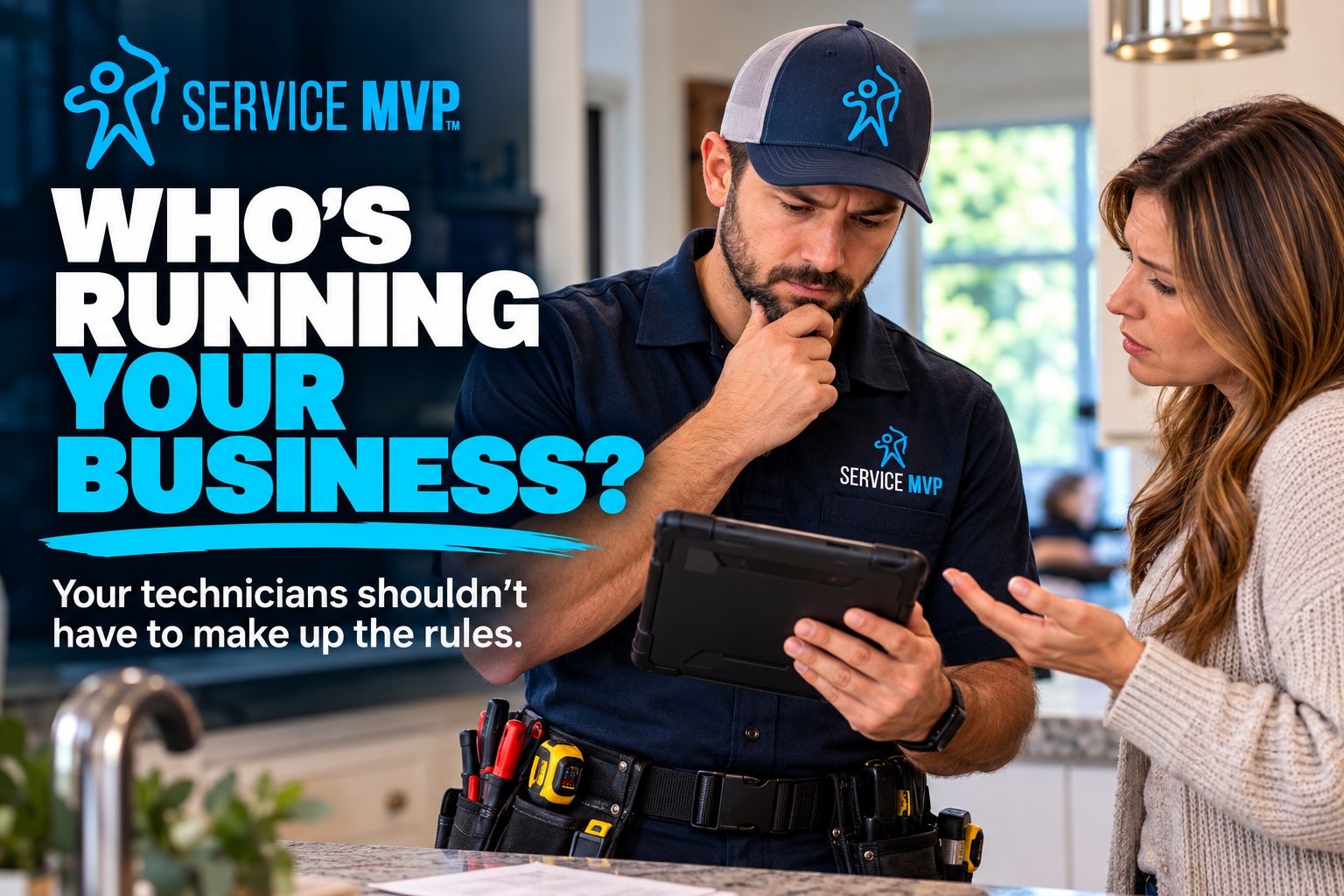
Your Technician Is Standing in Someone's Kitchen. Now What?
Picture this.
Your technician has just completed a diagnosis.
The homeowner wants to know what the repair will cost.
The technician opens the pricebook, finds the repair, and presents the price.
The homeowner says:
"That seems expensive. Can you do anything about it?"
Now what?
Does your technician offer a discount?
Call the office?
Explain why the price is what it is?
Offer a cheaper repair?
Walk away?
Here's the bigger question.
Who decided how that conversation should be handled?
Was it something your company trained the technician to do?
Or is your technician making it up as they go?
I've seen too many home service companies where the answer is the second one.
And then the owner wonders why every technician produces different results.
1. Stop Making Technicians Invent Your Business Process
Think about how much responsibility we place on technicians.
They need to diagnose complicated equipment.
Communicate with homeowners.
Protect the customer's property.
Document their findings.
Explain available solutions.
Present prices.
Handle objections.
Collect payment.
And somehow keep the schedule moving.
That's a lot.
But in many companies, there's another responsibility nobody talks about.
The technician is expected to figure out how the business should operate.
One technician offers a discount when a customer objects.
Another refuses.
One presents several repair and replacement options.
Another presents only the least expensive repair.
One calls the manager whenever there's a difficult conversation.
Another makes the decision independently.
And the owner wonders why the customer experience is inconsistent.
The problem isn't necessarily the people.
It's that the company hasn't defined what a consistent customer experience should look like.
2. Give Your Technicians Freedom Within a System
Some owners hear the word "process" and immediately worry that their technicians will sound scripted.
That's not what I'm suggesting.
I don't want technicians memorizing robotic conversations.
I want them to understand the purpose behind the process.
For example, at Service MVP, we teach technicians to ask questions that uncover what matters to the homeowner.
That doesn't mean every technician needs to ask the exact same questions in the exact same order.
It means every technician should understand the importance of listening before presenting a solution.
The process creates consistency.
The technician's personality creates the human connection.
A good system doesn't eliminate individual judgment. It gives that judgment a reliable foundation.
3. Your Pricebook Shouldn't Be a Negotiation Guide
Let's return to the homeowner who says the repair is too expensive.
If your technician immediately starts negotiating, what message does that send?
It may suggest the original price was arbitrary.
Or that customers who complain receive a better deal.
Or that your technicians have permission to change company pricing whenever a conversation becomes uncomfortable.
That's a dangerous way to operate.
Your company should establish pricing based on its actual costs, required profitability, and service standards.
The technician's job is to communicate the value of the solutions available—not invent a new price.
That doesn't mean every customer needs the most expensive solution.
It means the technician should understand how to present meaningful choices and help the homeowner decide what works best for their situation.
As we explain in Stop Giving Homeowners One Price: Why Service Technicians Should Present Options, giving homeowners choices can create a better buying experience than forcing them into a yes-or-no decision.
When your technicians understand how to offer options, they don't need to rely on discounts to make every sale.
4. Define Which Decisions Belong to the Technician
Here's an exercise I'd recommend for every service manager.
Write down the decisions your technicians regularly face.
Then separate them into two groups.
Decisions the technician should be empowered to make:
-
- Which diagnostic steps are appropriate for the equipment and situation.
- Which technically sound solutions are available.
- How to explain findings clearly to the homeowner.
- How to respond to the customer's questions and concerns.
- When a safety issue requires stopping work or escalating the situation.
Decisions that should follow company policy or require management approval:
-
- Changing established pricing or offering unauthorized discounts.
- Promising exceptions to warranty policies.
- Committing the company to unusual payment arrangements.
- Making commitments outside the approved scope of work.
- Handling disputes that exceed the technician's authority.
The exact boundaries will depend on your business.
But your technicians shouldn't have to guess where those boundaries are.
When they know what they can decide and when they should ask for help, they're more confident.
And your company is better protected.
5. Don't Make the Manager the Answer to Every Question
There's another side to this problem.
Some businesses go too far in the opposite direction.
Every question requires a phone call.
Every unusual situation requires approval.
Every customer concern gets escalated.
Now the manager spends the entire day answering questions that should have been resolved through training and clear policies.
That's not effective leadership.
The goal should be to make technicians more capable, not more dependent.
For example, if a technician calls because a homeowner wants to understand why a repair costs what it does, that may be an opportunity for coaching.
Instead of taking over the conversation, the manager might ask:
"What did the homeowner say was concerning them?"
"What have you explained so far?"
"What options have you presented?"
"What do you think would help the homeowner make an informed decision?"
Now you're developing the technician's ability to handle that situation next time.
Of course, there will always be situations where a manager needs to step in.
But every routine question shouldn't require management intervention.
6. Train for the Situations That Actually Happen
I've watched companies spend hours reviewing technical procedures while giving almost no attention to the conversations technicians have every day.
Yet those conversations are where many business problems begin.
A homeowner asks why the repair costs so much.
A customer wants to know whether replacement is a better investment.
Someone asks for a warranty exception.
A homeowner is upset because the problem returned.
A technician discovers additional issues that weren't part of the original appointment.
What happens next?
Your team should practice those situations before they occur.
Roleplay the difficult conversations.
Review your policies.
Discuss how to present options.
Make sure technicians know when to involve a manager.
And help them understand why the company handles situations the way it does.
We've written before about why technicians need to practice communication skills, not simply learn what they're supposed to say.
That principle is especially important when technicians face decisions that affect the customer and the company.
7. Your Dispatch and Management Systems Have to Support the Process
A technician can follow the right process only if the rest of the company supports it.
Imagine telling technicians to take time with customers and perform complete diagnoses.
But dispatch schedules them so tightly that every additional question puts them behind.
Or management tells technicians to present meaningful choices, but the pricebook doesn't contain the options they need.
Or the company expects excellent communication, but managers measure performance only by how quickly technicians finish calls.
Now your systems are working against your training.
That's why leadership, pricing, dispatch, and technician development cannot operate independently.
Every department should be supporting the same customer experience.
And when a technician struggles to follow the process, managers should ask whether the process itself is creating unnecessary obstacles.
8. Use Call-by-Call Coaching to Improve Judgment
One of the best ways to develop technicians is to review actual service calls.
Not just the revenue.
Not just whether the customer purchased.
But the decisions that happened throughout the appointment.
What did the technician discover?
What did the homeowner say?
What options were available?
How did the technician respond to concerns?
Was there a moment when the technician wasn't sure what to do?
That's where coaching becomes valuable.
A manager can help the technician understand what worked, what didn't, and what to do differently next time.
Over time, those conversations build better judgment.
And better judgment creates greater independence.
The goal of coaching isn't to make technicians ask permission more often. It's to help them make better decisions without needing permission.
9. Give Your Team a Clear Standard for Great Service
If you want to reduce inconsistent decisions, start by answering a few questions as a leadership team.
What should every customer experience when they call our company?
What should every technician do before presenting a solution?
How should we explain pricing?
What choices should homeowners receive?
When can a technician make an exception?
When must a manager get involved?
How should we handle a customer who is unhappy?
Then document those expectations.
Train them.
Practice them.
And reinforce them through coaching.
Don't assume your technicians know the answers simply because they've worked in the industry for years.
Experience doesn't automatically create consistency.
A well-defined process does.
Your Technicians Shouldn't Have to Run the Company From the Customer's Home
Here's what I want owners to remember.
Your technicians have enough responsibility already.
They need to diagnose problems correctly, communicate with homeowners, and deliver excellent service.
They shouldn't also be responsible for deciding how your business handles pricing, policies, warranties, and customer disputes.
Those decisions need to be established by leadership.
And technicians need the training and support to apply them.
When you create clear expectations, your team can work with greater confidence.
Your managers can spend less time putting out fires.
And your customers receive a more consistent experience.
Give your technicians the freedom to serve the customer - but don't make them invent the rules of your business while they're doing it.
Build a Team That Knows What Great Service Looks Like
At Service MVP, we help home service companies build consistent customer experiences through technician training, leadership development, and ongoing coaching.
Our Total Immersion training helps technicians develop the communication, diagnosis, and presentation skills they need to serve homeowners confidently.
And our coaching programs help managers reinforce those skills through clear expectations, practice, and accountability.
Because great service shouldn't depend on which technician happens to arrive at the customer's door.
