
Why Do My Employees Keep Making the Same Mistakes?
Why Do My Employees Keep Making the Same Mistakes?
By Joe Crisara, Author of What Should We Do? and Co-Founder of Service MVP
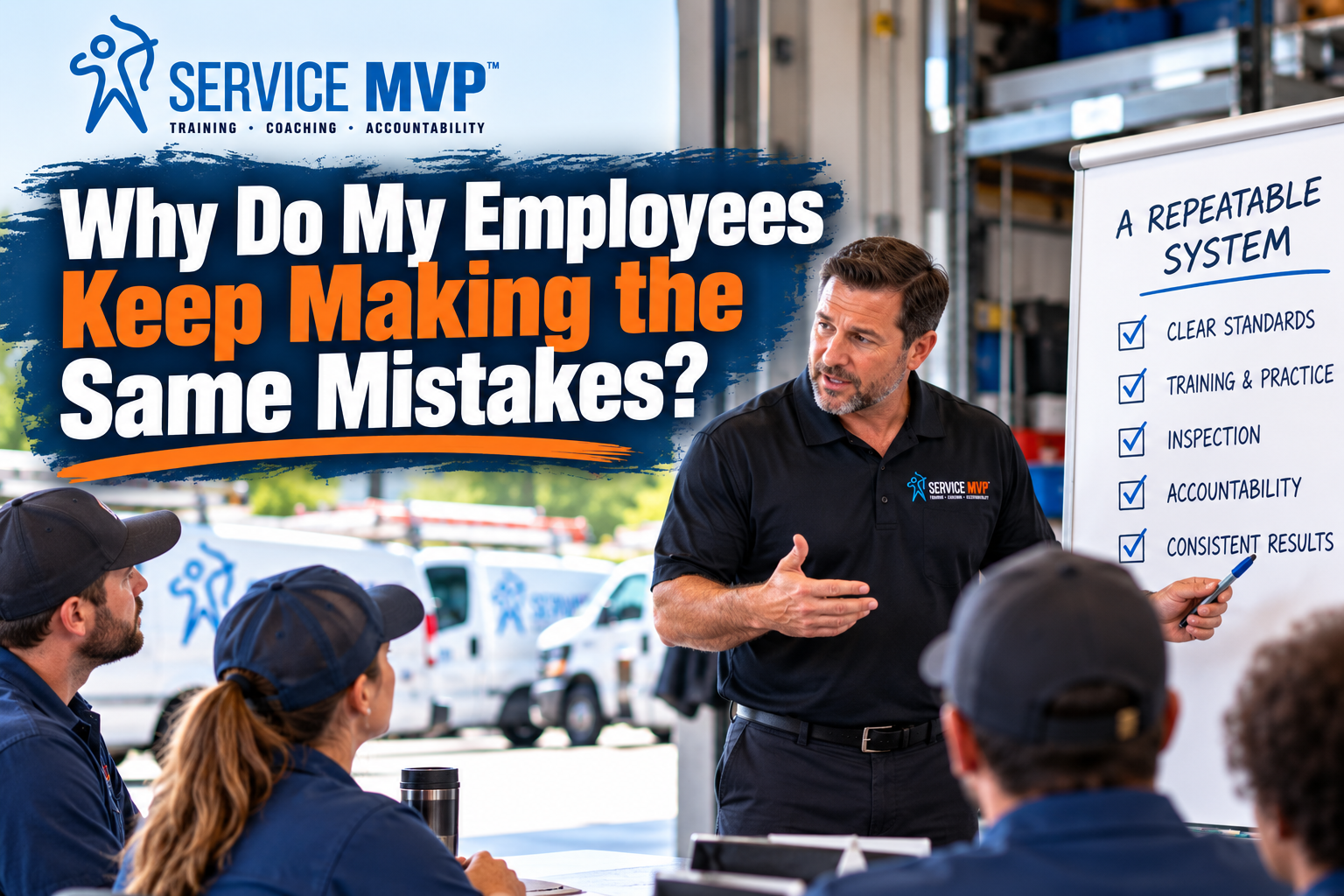
If your employees keep making the same mistakes, the problem may not be the employee. Before assuming someone doesn't care, isn't paying attention or needs to be replaced, look at the system surrounding the work. Was the standard clearly defined? Was the employee trained to perform it? Did they practice it? Does someone inspect the result? Is there accountability when the process isn't followed?
When the correct way to do something exists only in the owner's head, employees are forced to fill in the blanks themselves. If you want consistent results, you need more than good people. You need good people working inside repeatable systems.
“Why Do I Have to Keep Telling Them?”
I've heard some version of this from contractors for years.
“Joe, I've told them a hundred times.”
Put the paperwork here.
Restock the truck this way.
Take pictures before you begin the work.
Follow up with the customer.
Offer the membership.
Use the script.
Clean the warehouse.
Complete the invoice.
Present all the options.
And yet, somehow, you're having the same conversation again.
Eventually the frustration turns into:
“Why can't I find people who just do what they're supposed to do?”
Sometimes you really do have a people problem.
But before you decide that, I want you to ask a harder question:
Did I actually build a system - or did I just tell somebody what I wanted them to do?
Those aren't the same thing.
Telling Someone Once Isn't a System
Owners often carry an enormous amount of information in their heads.
That's especially true if you built the company yourself.
You know how you want the phones answered.
You know how you want a service call handled.
You know what should be stocked on the trucks.
You know when something doesn't look right on an invoice.
You know how you want a customer concern resolved.
You've probably done these things thousands of times.
So they're obvious to you.
But obvious to you doesn't mean obvious to everyone else.
If the process is:
“Just ask me if you're not sure,”
you don't have a system.
You have a company that depends on you.
A System Should Answer Questions Before the Employee Has to Ask Them
Think about yesterday's truck inventory example.
Imagine telling a technician:
“Keep your truck stocked.”
What does that mean?
Which parts?
How many?
Where should they go?
When should they be replenished?
Who replenishes them?
How does the technician report that something was used?
What happens with a damaged part?
How often is the truck inspected?
What does a properly stocked truck actually look like?
If you haven't answered those questions, two technicians can both genuinely believe they're doing what you asked—and produce completely different results.
Then the owner looks at one truck and says:
“Why can't you do it like Mike does?”
Because Mike created his own system.
You never created the company's system.
Stop Training by Tribal Knowledge
This becomes an even bigger problem as a home service company grows.
When there are three people, everybody talks to everybody.
Someone forgets something and the owner catches it.
A new employee has a question and walks into the office.
People learn by watching whoever has been there the longest.
That can work for a while.
Then you have 10 people.
Then 20.
Now the CSR teaches the new CSR what she remembers.
Technician A trains Technician B based on his interpretation.
The service manager explains something differently than the owner.
Eventually, you don't have one company operating system.
You have a collection of individual habits being passed from person to person.
That's tribal knowledge.
And tribal knowledge is very difficult to scale.
Write Down What “Good” Looks Like
One of the simplest leadership exercises you can do is choose a recurring problem in your company and define the expected result.
Not:
“Do a better job.”
Define better.
Not:
“Give great customer service.”
Define what great customer service looks like.
Not:
“Keep your truck clean.”
Show what a properly organized truck looks like.
Not:
“Make sure you follow up.”
Define who follows up, when they do it, how they do it and what happens next.
People can't consistently hit a target they can't see.
A good standard makes the target visible.
But Writing an SOP Isn't Enough Either
This is where companies can swing too far in the other direction.
The owner gets excited about systems and suddenly creates a 97-page SOP manual.
Great.
It goes into a binder.
The binder goes onto a shelf.
And nobody looks at it again.
Documentation is part of a system. It isn't the entire system.
For a process to become part of the way your company operates, people need to learn it, practice it, use it and receive feedback on it.
That's why at Service MVP we put so much emphasis on repetition.
You wouldn't hand an apprentice a manual on brazing, have them read it once and then assume they had mastered the skill.
Communication, customer service, leadership and operational processes deserve practice too.
Training Isn't an Event
This is one of the biggest mistakes I see owners make.
They conduct a meeting.
They explain the new process.
Everybody nods.
The owner asks:
“Does everybody understand?”
Everybody says yes.
Meeting over.
Three weeks later, nobody is doing it.
Now the owner is angry because:
“We already trained on this!”
No.
You introduced it.
Training is what happens next.
They need to practice.
They need coaching.
They need someone to observe whether they're doing it correctly.
They need correction when they're not.
And they need reinforcement when they are.
If something matters enough to become a company standard, it matters enough to train more than once.
Inspect What You Expect
There's an old leadership principle behind this, and it's still useful:
You can't simply expect. You have to inspect.
If truck inventory matters, inspect the trucks.
If call booking matters, listen to calls.
If options matter, review estimates.
If customer communication matters, look at what customers are receiving.
If technician training matters, watch technicians practice.
If follow-up matters, measure whether follow-up happened.
Inspection doesn't have to mean micromanagement.
It means the company has a way of knowing whether its important systems are actually being followed.
Because without inspection, the owner usually discovers a broken process only after it creates a problem.
Accountability Comes After Clarity
Owners sometimes jump straight to accountability.
“I'm going to start writing people up.”
Maybe that's appropriate.
But first ask:
Did they know exactly what was expected?
Were they given the tools to do it?
Were they trained?
Did they have an opportunity to practice?
Was the standard being consistently enforced?
If the answer is yes and someone repeatedly chooses not to follow the process, now you may have a performance problem.
That's different.
Accountability without clarity feels arbitrary. Accountability after clarity feels fair.
Your employees should know what winning looks like.
Don't Change the Standard Every Tuesday
There's another way owners accidentally create inconsistency.
They keep changing the process.
Monday:
“We're doing it this way now.”
Tuesday morning something happens:
“Forget that. Do this.”
Wednesday:
“I talked to somebody at a conference and we're changing it again.”
By Friday the team is waiting to see whether the newest idea survives the weekend.
Innovation is good.
But constant improvisation can train employees not to take new systems seriously.
Test improvements.
Measure them.
Make changes when they make sense.
But once you've established a standard, give your team a chance to master it.
The Owner Has to Follow the System Too
This one can hurt.
You establish a process for scheduling.
Then your favorite customer calls and you tell dispatch to ignore it.
You establish pricing.
Then you discount something because the homeowner is a friend.
You establish a process for customer concerns.
Then you jump in and promise something completely different.
Your team is watching.
If the system disappears every time the owner enters the room, it isn't really the company's system.
It's a suggestion.
Leadership means following the standards you expect everyone else to follow—or intentionally changing the standard for everyone when you've learned there's a better way.
When Does It Actually Become a People Problem?
Systems don't eliminate accountability.
And they don't mean every employee is the right employee.
Sometimes the process is clear.
The training happened.
The employee demonstrated that they understand it.
They have the tools.
The expectations are reasonable.
Feedback has been provided.
And they still repeatedly choose not to follow the standard.
Now you have different information.
The system has helped you distinguish between someone who couldn't succeed because the process was unclear and someone who won't meet a clearly established expectation.
That's one of the hidden benefits of good systems.
They don't just make good employees better.
They make performance problems easier to see.
Build a Business That Doesn't Need You to Remember Everything
The goal of systems isn't to turn your company into a bunch of robots.
It's the opposite.
Systems take repetitive decisions off people's shoulders so they can focus more attention on the situations that actually require judgment, empathy and expertise.
Your CSR shouldn't have to invent your cancellation process every time someone calls.
Your technician shouldn't have to invent your inventory system.
Your dispatcher shouldn't have to guess how calls should be prioritized.
Your manager shouldn't need to call you every time something unusual happens.
And you shouldn't have to walk through the building reminding everybody what they're supposed to be doing.
The business should carry more of that knowledge for you.
Before You Blame the Employee, Look at the Process
The next time you catch yourself saying:
“Why do they keep making the same mistake?”
Don't immediately answer the question.
Investigate it.
Was there a standard?
Was it documented?
Was it taught?
Was it practiced?
Was it inspected?
Was feedback given?
Was there accountability?
If all of those things happened, you may have an employee problem.
But if they didn't?
You may have just found the next system your business needs to build.
Want Help Building a Business That Doesn't Depend on You for Every Answer?
At Service MVP, we don't just work on technician communication. We help home service owners identify the systems that are limiting growth and build repeatable processes their teams can actually execute.
