
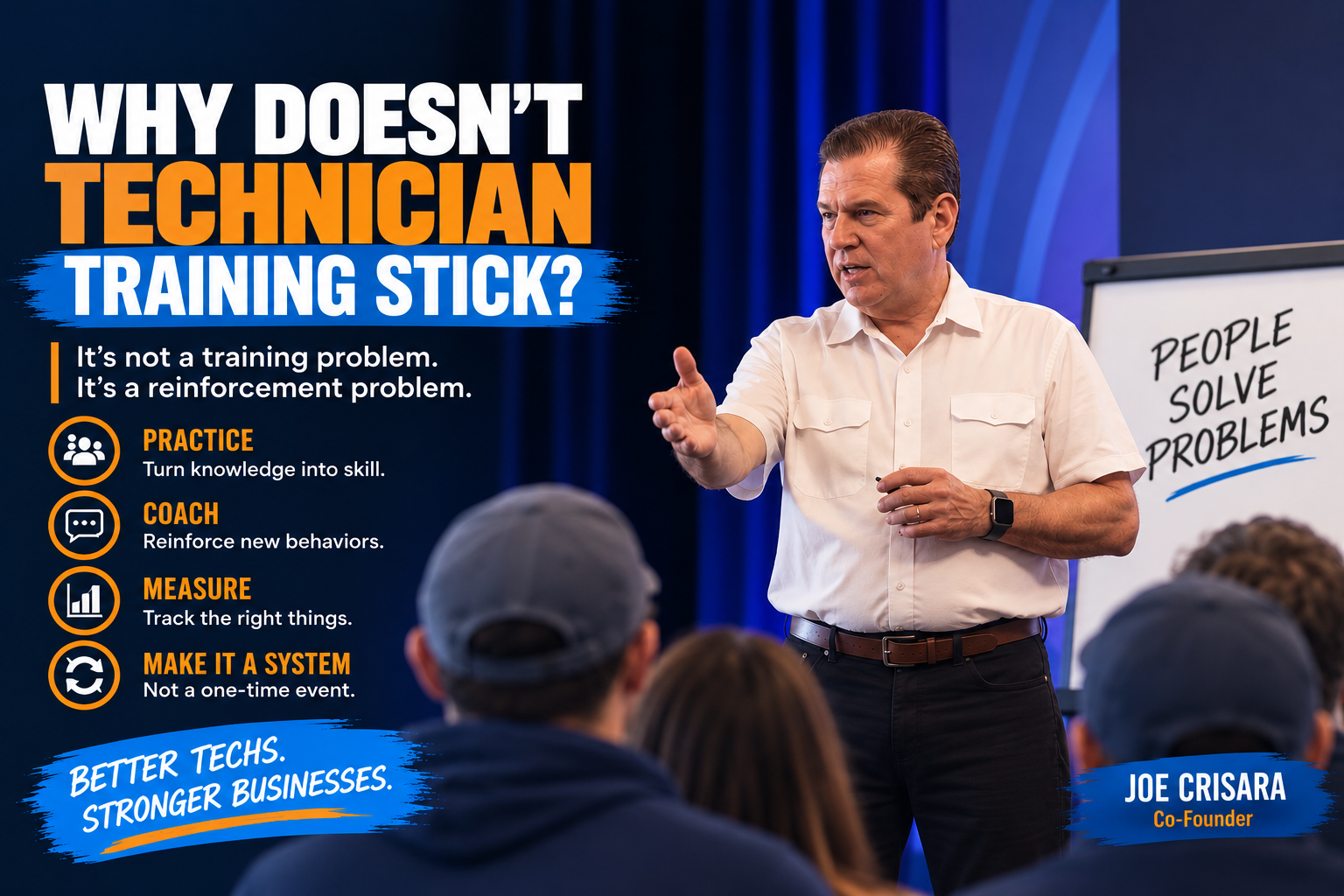
Why Doesn’t Technician Training Stick?
Why Doesn’t Technician Training Stick?
By Joe Crisara, Author of What Should We Do? and Co-Founder of Service MVP
You send your technicians to training. They come back energized. For a few days - or maybe a few weeks - you hear better questions, see better communication, and notice people trying the new process.
Then something happens.
The old habits start creeping back in.
The questions get shorter. The process gets skipped. Role-play disappears. Managers get busy. Before long, everyone is doing things pretty much the way they did before the training.
So was the training a waste?
Probably not.
The bigger problem is that too many home service companies treat technician training as an event when it needs to be a system.
If you want training to change what technicians actually do in customers' homes, the work can't end when the class does.
Training Isn't the Same as Behavior Change
There's a big difference between understanding something in a classroom and being able to execute it naturally with a homeowner.
A technician can understand how to:
- ask better discovery questions,
- explain technical findings in homeowner-friendly language,
- identify additional opportunities,
- build meaningful options,
- present pricing confidently,
- work through customer concerns,
- and help a homeowner make a decision.
- But understanding those skills doesn't make them automatic.
Think about technical training.
You wouldn't show a new technician one video on diagnosing an electrical problem, hand over the keys to a truck, and assume the skill was mastered.
Yet companies often do exactly that with communication.
They hold a meeting. They teach a process. Everyone nods.
Then leadership says:
"Great. Go do it."
That's why we've talked before about why technicians need to practice what they learn. Knowledge is only the beginning. Repetition is what begins turning knowledge into skill.
The Real Test Starts After the Training Ends
The first service call after training is where the real training begins.
Now the technician has a homeowner standing in front of them.
The phone is ringing.
Dispatch is asking when they'll be finished.
The equipment isn't doing what they expected.
The customer has questions.
And suddenly the technician has to remember everything they learned while also diagnosing the problem, communicating clearly, navigating the pricebook, building options, and managing the call.
Under pressure, people tend to return to what feels familiar.
That's why the weeks after training may be more important than the training itself.
If Leadership Doesn't Reinforce It, the Old Process Usually Wins
Imagine teaching technicians a new five-step service process on Monday.
On Tuesday, their manager asks only:
"How much did you sell?"
Wednesday:
"How many calls did you run?"
Thursday:
"Why did this call take so long?"
Friday:
"What's your average ticket?"
What did the company actually reinforce?
Not the five-step process.
It reinforced speed and revenue.
Employees pay attention to what leadership consistently asks about, observes, celebrates, corrects, and measures.
If you want technicians to adopt new behaviors, leaders have to reinforce those behaviors after the training.
That might mean asking:
What did you discover?
What questions did you ask?
How many legitimate opportunities did you identify?
What options did you give the homeowner?
What mattered most to the customer?
What happened when the homeowner had a concern?
Those questions tell the technician:
This process still matters.
Stop Training Your Technicians Once
One of the biggest mistakes in home service technician training is expecting permanent improvement from a single exposure.
Imagine trying to learn golf that way.
You attend an eight-hour golf class.
You learn the stance, grip, swing, club selection, putting, and course strategy.
Then you never practice again.
Six months later, someone asks:
"Why aren't you better at golf?"
The answer is obvious.
Skills deteriorate when they aren't used and reinforced.
Communication skills are no different.
The answer isn't necessarily more classroom training.
It's shorter, more frequent reinforcement.
Ten minutes of role-play.
Listening to one service call.
Reviewing one customer interaction.
Practicing one objection.
Coaching one discovery question.
Reviewing one set of options.
Small repetitions performed consistently can produce far more behavioral change than repeatedly waiting for the next big training event.
Role-Play Shouldn't Be a Punishment
Mention role-play in some home service companies and watch everyone's eyes hit the floor.
Nobody wants to be picked.
That's usually because role-play has been turned into a performance.
Someone gets called to the front of the room while everybody watches and waits for them to mess up.
That's not practice. That's pressure.
Good role-play should create a safe place to make mistakes before those mistakes happen in a customer's home.
Make it short.
Make it specific.
Practice one skill at a time.
One technician plays the homeowner. Another practices the conversation. Then switch.
The goal isn't perfection.
It's repetition.
And leaders should participate too.
When technicians see managers and owners practicing the same skills they're being asked to practice, training stops feeling like something leadership does to employees.
It becomes something the company does together.
Your Technicians May Not Have a Sales Problem
Sometimes companies keep retraining the close when the real breakdown is happening much earlier.
The technician never asked enough questions.
They investigated only the immediate failure.
They didn't uncover the homeowner's concerns.
They missed legitimate conditions elsewhere in the system.
Then management looks at the low invoice and concludes:
"We need more sales training."
Maybe.
But perhaps the technician needs better discovery training.
That's why a technician who appears to have a closing problem can actually have an opportunity-identification problem.
You can't present a solution for something you never discovered.
And you can't coach the right skill until you've identified where the process is actually breaking down.
Observe the Behavior Before You Coach the Result
Revenue tells you what happened.
It doesn't always tell you why it happened.
Suppose two technicians each generate $1,500 in revenue.
Technician A thoroughly investigates the system, identifies five legitimate opportunities, explains them clearly, presents several meaningful choices, and the homeowner selects $1,500 worth of work.
Technician B identifies one issue, gives one price, and the homeowner happens to approve a $1,500 repair.
The revenue is identical.
The behaviors are not.
Which process would you rather duplicate across 20 technicians?
That's why leaders need to look upstream from the revenue.
Watch the behaviors that create the result.
Your Compensation Plan Can Reinforce, or Undermine, Your Training
There is another reason training sometimes doesn't stick.
The company teaches one behavior and pays for another.
Leadership might tell technicians:
Slow down. Ask questions. Serve the customer. Don't prejudge. Present meaningful choices.
But if the compensation plan communicates:
Produce revenue or lose money,
the technician is receiving two different messages.
Guess which one tends to win?
We've talked about this in Should Home Service Technicians Be Paid Commission? The question isn't simply whether commission is good or bad. The bigger question is whether your compensation system rewards the behaviors you're trying to create.
Your training, coaching, KPIs, compensation, and leadership expectations should all point in the same direction.
Don't Let Dispatch Undo the Training Either
A company can spend thousands of dollars teaching technicians to slow down, investigate thoroughly, connect with homeowners, and build better options.
Then dispatch texts:
"Need you at the next call ASAP."
That message can undo a surprising amount of training.
If your technicians constantly feel pressure to finish the current call so they can reach the next one, don't be surprised when they begin skipping
parts of the process.
We've already looked at why rushing technicians between service calls can cost you revenue.
Training can't live in isolation.
Your scheduling, dispatching, compensation, KPIs, software, leadership, and company culture all have to support the behavior you're teaching.
The Leader Becomes the Training System
This may be the biggest lesson of all.
Great training can introduce a skill.
Leadership makes it stick.
The trainer can't be standing beside your technician three months later.
The owner can't attend every service call.
Eventually, the company's leaders have to become coaches.
That doesn't mean giving hour-long lectures.
It means consistently noticing behavior.
Ask questions.
Observe.
Practice.
Recognize improvement.
Correct drift early.
And hold people accountable without waiting until the monthly revenue report tells you something went wrong.
When leadership does that consistently, training stops being something the company attends.
It becomes part of how the company operates.
Training Should Have a Rhythm
If I were evaluating a home service company's technician training program, I wouldn't start by asking:
"When was your last training?"
I'd ask:
"What happens this week?"
Is there role-play?
Is someone observing field performance?
Does a leader review calls?
Are technicians practicing specific skills?
Is somebody coaching the behaviors behind the KPIs?
Does the team know what skill they're currently working to improve?
That's the difference between having training and having a training culture.
You don't need to retrain everything every week.
Pick one thing.
Practice it.
Observe it.
Coach it.
Measure it.
Then build on it.
The Goal Isn't to Remember the Training
Ultimately, you don't need technicians walking around saying:
"I remember what Joe taught us."
You need them doing it without having to think about it.
The right question isn't:
"Did everyone attend the training?"
It's:
"Did the behavior change?"
And if the behavior changed temporarily but disappeared three weeks later, don't automatically blame the technician—or the training.
Look at what happened when everyone returned to work.
Was the new behavior practiced?
Was it observed?
Was it coached?
Was it measured?
Was it reinforced by leadership?
Because training introduces the standard.
Your company has to keep it alive.
Want Training That Actually Changes What Happens in the Home?
Service MVP's Total Immersion training is built around practice, role-play, repetition, coaching, and real-world customer conversations—not simply sitting in a classroom and taking notes.
But the work doesn't stop there. Service MVP's Coach Guided Training helps owners and leaders continue reinforcing those skills so training becomes part of how the company operates.
