
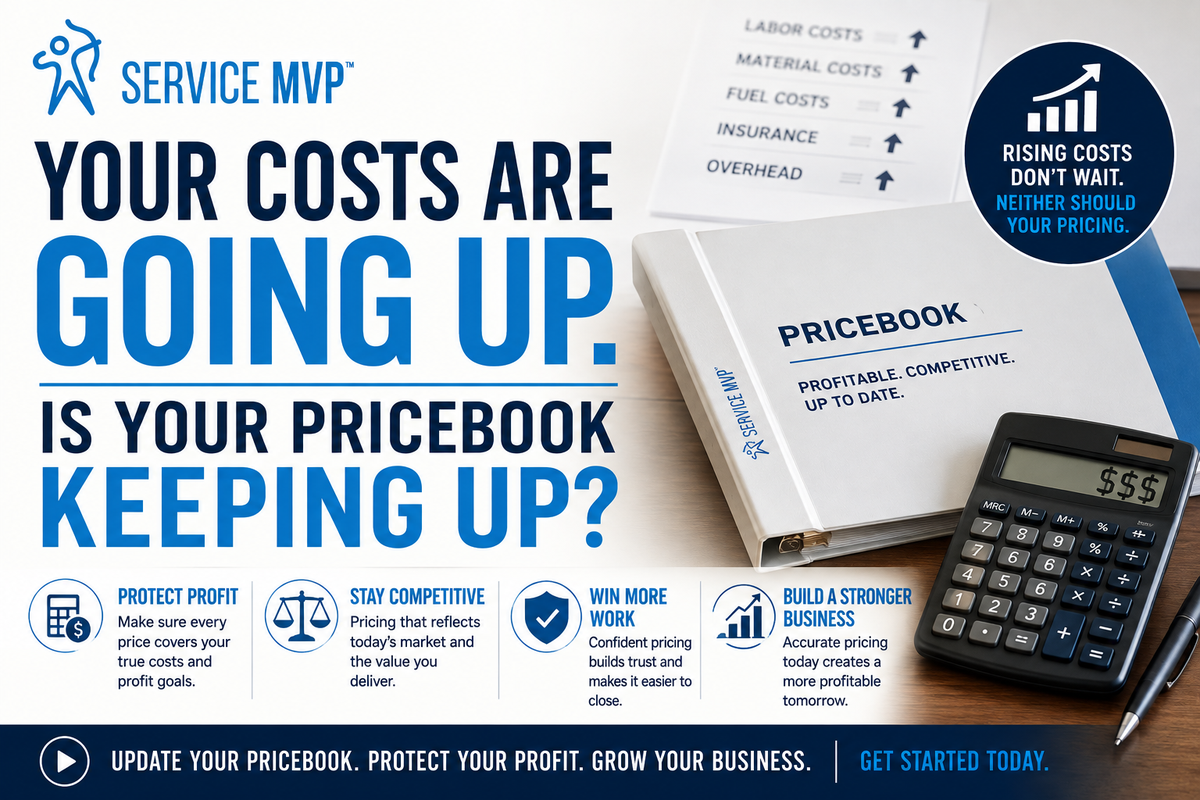
Your Costs Are Going Up. Is Your Pricebook Keeping Up?
Your Costs Are Going Up. Is Your Pricebook Keeping Up?
By Joe Crisara, Author of What Should We Do? and Co-Founder of Service MVP
Fuel. Materials. Equipment. Insurance. Labor. Vehicles.
For home service contractors, the cost of doing business rarely moves in one direction for very long.
And lately, one expense has been particularly hard to ignore: the cost of keeping your trucks on the road.
When fuel prices climb, every service call gets a little more expensive. Every mile between calls costs more. Every unnecessary trip back to the shop costs more.
But here's the bigger issue:
Fuel is only one of the costs quietly changing underneath your pricebook.
If your expenses are changing but your prices aren't, you're not holding your margins steady.
You're shrinking them.
So instead of asking, “How do we deal with higher fuel prices?” there's a much more important question every HVAC, plumbing, electrical, and home service contractor should be asking:
Are our prices still based on what it actually costs us to do business today?
1. Find Out Where Your Costs Have Actually Increased
The first mistake is assuming you already know the answer.
Fuel might be the expense getting everyone's attention, but it may not be the expense doing the most damage.
Look at what you're actually paying for:
- Fuel
- Materials and parts
- Equipment
- Vehicle maintenance
- Commercial insurance
- Employee wages and benefits
- Financing
- Software
- Rent and facilities
- Marketing
- Training
- Administrative overhead
Then compare those numbers with what they were when you last updated your pricing.
You may discover that the $20 or $30 difference in fuel isn't nearly as significant as the increase in labor, insurance, equipment, or overhead.
Don't adjust your prices based on headlines. Adjust them based on your numbers.
2. Know What It Really Costs to Put a Truck in the Driveway
Contractors sometimes look at the cost of a service call and think primarily about the technician's hourly wage and the fuel required to get there.
But that's not what it costs to put that truck in a customer's driveway.
You're paying for the truck.
Insurance.
Fuel.
Maintenance.
Tools.
Inventory.
Technician's wages and benefits.
Training.
Dispatch.
Customer service.
Management.
Technology.
Marketing.
And all the other infrastructure required to make that service call possible.
That's why knowing your profitable hourly rate is so important.
If your company needs a certain amount of revenue per productive hour to cover overhead and produce the profit necessary to remain healthy, your pricing has to be built around that reality.
Otherwise, you can be busy all day and still wonder where the money went.
3. Don't Wait for Your P&L to Tell You There's a Problem
One of the most dangerous things about rising costs is that they don't necessarily create an obvious crisis.
Your phones can still ring.
Your technicians can still run calls.
Revenue can still look good.
But underneath all that activity, your margins can slowly disappear.
A few dollars here.
Another percentage point there.
A supplier increase you absorbed.
A wage increase you never completely accounted for.
Higher insurance premiums.
Higher fleet expenses.
More expensive financing.
None of them necessarily destroys profitability on its own.
Together, they can.
And by the time your financial statements make the problem obvious, you may have already sold hundreds or thousands of jobs at prices that no longer support the business.
Your pricebook shouldn't be something you build once and forget.
It needs to move when your business moves.
4. Be Careful With Fuel Surcharges
When fuel prices spike, one of the easiest reactions is to add a fuel surcharge.
Sometimes that may make sense.
But think about the experience from the homeowner's perspective.
They called because their air conditioner stopped cooling, their drain backed up, their electrical panel needs attention, or their water heater failed.
Then the invoice arrives with another line:
Fuel surcharge.
From the contractor's perspective, it's completely logical.
From the homeowner's perspective, it can feel like they're being charged because your truck needed gasoline.
That's why I generally prefer making sure the company's overall pricing accurately reflects the true cost of providing service rather than chasing every changing expense with another fee.
Your customers don't need to understand every individual cost inside your business.
You do.
And your pricing needs to account for them.
5. Reduce the Miles You Don't Need to Drive
Pricing isn't the only lever available.
If every mile is becoming more expensive, look for ways to eliminate miles that aren't producing value.
Better routing and dispatching can help.
So can making sure trucks are properly stocked.
Every time a technician has to drive back to the shop because they don't have a common part, you're paying twice: once in lost productive time and again in vehicle expense.
Callbacks matter, too.
Doing the job correctly the first time isn't just good customer service. It prevents you from paying to send another truck back to the same house.
Look at:
Routing. Inventory. Dispatching. First-call completion. Callbacks.
Small operational improvements become increasingly valuable as the cost of operating your fleet increases.
6. Make More of the Opportunities You're Already Paying to Reach
This may be the most overlooked opportunity of all.
You've already spent the money.
You marketed to the customer.
Someone answered the phone.
The call was booked.
A dispatcher managed the schedule.
A trained technician climbed into an insured, stocked vehicle.
You bought the fuel.
And now that technician is standing in the customer's driveway.
What happens next matters enormously.
If the technician rushes in, fixes the one thing the homeowner called about, collects payment and leaves, you may have missed other legitimate opportunities to serve that customer.
That's not about selling people things they don't need.
It's about slowing down enough to actually look, listen and ask.
What else is happening in the home?
What has the customer been putting off?
What concerns do they have?
What did the technician observe?
Are there safety, comfort, efficiency, reliability, health, convenience, or future-maintenance issues the homeowner should know about?
A great service professional doesn't make those decisions for the customer.
They identify the opportunities, explain what they've found, create appropriate choices, and let the homeowner decide.
That's one of the reasons presenting multiple options is so powerful.
Instead of:
“Here's what you need to do.”
the conversation becomes:
“Here are several ways we can help. Which one makes the most sense for you?”
The truck is already there.
The technician is already there.
The customer acquisition cost has already been spent.
Making the most of that opportunity can be far more profitable than constantly trying to generate another service call.
Don't Forget About the Opportunities You Already Found
There's another place many contractors can find revenue without putting another truck on the road to chase a brand-new lead:
work customers already considered but didn't purchase.
Look at your unsold estimates.
Deferred repairs.
Recommended upgrades.
Maintenance work.
Replacement opportunities.
Customers who said:
“Not right now.”
Not right now doesn't necessarily mean never.
Circumstances change. Seasons change. Equipment gets older. Priorities change.
A thoughtful follow-up can bring existing opportunities back into the business without spending additional marketing dollars to create them from scratch.
Again, this isn't about pressure.
It's about making sure customers know you're still available to help when they're ready.
You Can't Control the Price of Diesel
There will always be costs in your business you can't control.
You can't control what happens to oil prices.
You can't control what your insurance carrier decides to charge next year.
You can't control every supplier increase.
You can't control interest rates.
But you can control how quickly your company responds.
You can know your numbers.
You can maintain a profitable hourly rate.
You can keep your pricebook current.
You can improve routing and productivity.
You can reduce unnecessary trips.
You can follow up on opportunities you've already created.
And you can train your technicians to make the most of every opportunity to serve once you've already paid to put that truck in the driveway.
You can't control the price of diesel.
You can control what happens after the truck pulls into the driveway.
Is Your Pricing Keeping Up With Your Business?
At Service MVP, we help home service companies build the pricing, communication, and service systems that allow them to grow profitably - even when the cost of doing business changes.
Because raising prices isn't the goal.
Building a company that can remain profitable while continuing to provide exceptional service is.
If your costs have changed but your pricebook hasn't, now is a good time to take another look at the numbers.
And if your technicians are already driving to customers' homes every day, make sure they're equipped to identify opportunities, communicate value, and give homeowners meaningful choices once they get there.
The most expensive service call may be the one you already paid for - but didn't make the most of.
Ready to make sure your pricing, team, and service process are keeping up with your business?
