By Joe Crisara, America's Service Sales Coach and Author of What Should We Do?
Short answer
What should a technician do when the homeowner needs to talk to a spouse?
Your customer wanting to talk to their spouse isn't necessarily a sales objection. It might be the most responsible thing they've said all day. Your technician's responsibility is to help everyone involved understand the problem, the available solutions, and the investment.
Your technician has completed the diagnosis, explained the problem, and presented several solutions.
The homeowner seems interested. They understand the options. Everything appears to be going well.
Then come the words that make so many service technicians uncomfortable:
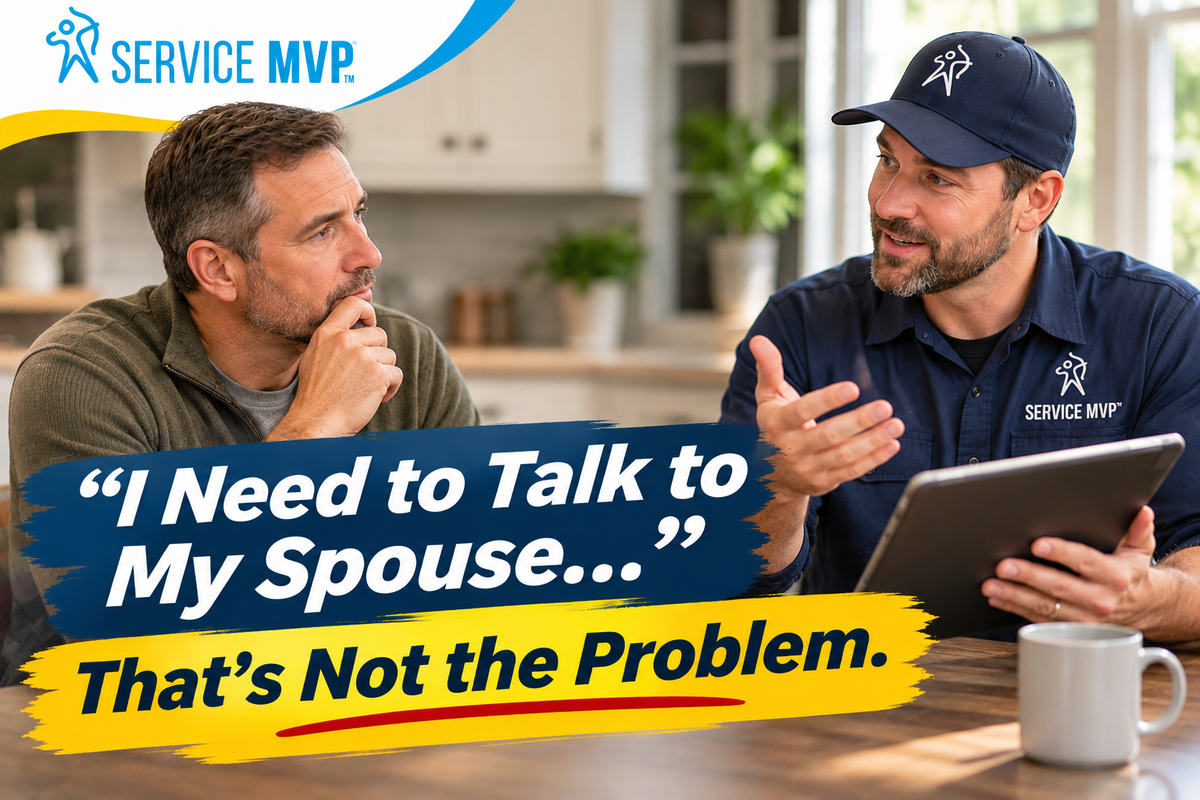
"I need to talk to my spouse before making a decision."
And just like that, the technician thinks the sale is slipping away.
Maybe they start explaining the price again. Maybe they offer a discount. Or worse, they try to convince the homeowner that they don't really need anyone else's approval.
But here's what I want every HVAC, plumbing, and electrical contractor to understand:
Your customer wanting to talk to their spouse isn't necessarily a sales objection. It might be the most responsible thing they've said all day.
And if your technician treats that responsibility like an obstacle, they could be creating a much bigger problem than a delayed sale.
Why "I Need to Talk to My Spouse" Isn't Always a Sales Objection
Think about the decisions homeowners make when they hire a service company.
A simple repair might cost several hundred dollars. A comprehensive plumbing solution could cost thousands. An HVAC equipment replacement could represent a significant household investment.
During one of our recent MVP Club training sessions, we built an option sheet for a garbage disposal replacement.
The most comprehensive solution was approximately $3,700.
Now imagine spending $3,700 of your family's money without discussing it with the other person who shares responsibility for that money.
Would that be reasonable in every household?
Of course not.
So why do some sales trainers teach technicians to push past that concern?
When a homeowner says they need to discuss a purchase with their spouse, they may be demonstrating respect, financial responsibility, and a desire to make a decision together.
That's not something we should discourage. It's something we should support.
The goal of professional service sales isn't to convince someone to make a decision they'll regret later.
It's to help everyone involved understand the problem, the available solutions, and the value of each choice.
The Biggest Mistake Technicians Make When a Customer Wants to Talk to Their Spouse
I've heard some terrible advice about handling this situation.
Some sales trainers encourage technicians to challenge the homeowner's authority.
They suggest saying things like:
"Who's making the decisions around here?"
Or:
"You don't need permission to fix your own house."
Seriously?
That's how we're going to treat someone who invited us into their home and trusted us to help them?
You might pressure someone into agreeing to a purchase that way.
But what happens after you leave?
What happens when their spouse comes home, discovers the expense, and asks why nobody discussed it with them?
Now the customer feels uncomfortable. Their spouse feels excluded. And your company becomes part of a disagreement that never needed to happen.
You may have won the sale, but you've damaged the relationship.
That's not Pure Motive Service.
At Service MVP, we teach technicians to help customers make informed decisions without manipulation, intimidation, or unnecessary pressure.
Because a sale that creates problems for the homeowner isn't the kind of sale we should be celebrating.
The $42,000 Sale That Disappears the Next Morning
Let me describe a situation that experienced contractors will recognize.
Your technician presents a comprehensive HVAC replacement proposal.
The homeowner agrees to a $42,000 solution.
Everyone's excited.
Your team orders the equipment, schedules the installation crew, and starts preparing for the job.
Then the phone rings.
The homeowner has spoken with their spouse.
And they've decided to cancel.
Now you're dealing with equipment orders, scheduling problems, possible restocking costs, and a customer who's frustrated.
What went wrong?
The technician may have presented the equipment beautifully. They may have explained every feature and answered every question.
But they missed something important.
They never confirmed that everyone who needed to participate in the decision had the information they needed.
I've seen versions of this situation happen with furnaces, air conditioners, water heaters, and plumbing projects.
Sometimes the cancellation happens before installation.
Sometimes the technician has already started working when another homeowner arrives and asks what's going on.
Neither situation creates a good customer experience.
And both are often preventable.
Stop Trying to Close the Sale. Start Bringing People Together.
Here's how I approach this situation differently.
Let's say I'm talking with a homeowner named Chris.
Chris has selected a comprehensive solution, but his wife, Caitlin, isn't home.
Rather than pushing Chris to approve the work immediately, I might say:
"Chris, I think you've selected a great solution. Before we move forward, let's make sure Caitlin understands what we've found and what you're considering. I'd be happy to explain everything to her so you don't have to do that on your own."
Notice what I'm doing.
I'm not questioning Chris's ability to make decisions.
I'm not suggesting that Caitlin needs to give him permission.
I'm offering to make the decision easier for both of them.
And I'm taking responsibility for communicating the technical information accurately.
That's what a professional service advisor should do.
We shouldn't expect homeowners to remember every technical detail and then explain our recommendations to someone who wasn't present.
That's our job.
Two Ways to Handle the Spouse Objection Without Pressure
When another homeowner needs to be included, there are two practical approaches I recommend.
Option 1: Present the Solutions, Then Include the Other Person
You can complete the presentation with the homeowner who's present.
Let them ask questions, compare options, and identify the solution they prefer.
Then offer to include their spouse before finalizing the decision.
For example:
"Chris, now that you've seen the options, which solution do you feel would work best for your family?"
After they answer:
"Great. Let's see if Caitlin has a few minutes so I can explain what we found and why you're considering that solution. Then you two can decide what makes the most sense."
This approach allows the homeowner to participate fully without placing the burden of explaining technical information on them.
Option 2: Present the Solutions to Both Homeowners Together
Sometimes it's better to wait until both people can participate.
You might say:
"Chris, since this affects both of you, would it be easier to get Caitlin on the phone while I explain the options? That way, you can both hear the same information and ask any questions before deciding."
A phone call or video conversation may be enough.
If the other person isn't available, you can arrange an appropriate follow-up.
The important thing is that you're making participation easier rather than treating it as an inconvenience.
And remember: every household handles decisions differently. Some people have agreed that one person will manage certain purchases independently.
Respect those arrangements, too.
The objective is to understand how your customer wants to make the decision—not impose your own rules on their household.
The Best Time to Handle This Objection Is Before It Happens
Here's where most technicians get the process backward.
They wait until the end of the appointment to discover that another person needs to be involved.
By then, they've spent time diagnosing the problem, building options, and presenting solutions.
Now they have to repeat everything.
But what if they had identified the situation at the beginning of the call?
During the initial customer conversation, we teach technicians to ask questions that help them understand the household and how the equipment affects the people living there.
Questions such as:
- Who uses this heating and cooling system?
- Who first noticed the problem?
- How has this issue affected everyone in the home?
- Is there anyone else who would like to understand what we find?
- When we review the solutions, would you prefer to include anyone else in that conversation?
These aren't interrogation questions.
They're opportunities to understand the customer.
For example, if a homeowner explains that their spouse first noticed the upstairs bedrooms weren't cooling properly, that's useful information.
The spouse may have observations that help with the diagnosis.
They may also have concerns about comfort, noise, energy costs, or reliability that the person you're speaking with hasn't mentioned.
Including the right people doesn't just make the purchase decision easier. It can help you develop better solutions.
And if someone else wants to participate, you can arrange that while you're completing the diagnosis instead of waiting until the presentation is finished.
What If the Homeowner Says, "My Spouse Doesn't Want to Be Involved"?
This is where technicians need good judgment.
Sometimes a homeowner will say:
"My wife doesn't care about this stuff. She told me to buy whatever I think is best."
That may be completely true.
Not every couple makes every purchasing decision together.
And it's not our responsibility to tell customers how their relationships should work.
But we can still make sure the customer understands the investment and has the information they need.
I might respond:
"That's great. It sounds like you've already discussed who will handle this. Would it be helpful if I put together a clear summary of the problem and the options so you can share it with her if you'd like?"
If the customer wants their spouse included, help make that happen.
If they've clearly established that they're authorized to make the decision, respect that.
Our job is to make the buying experience transparent and comfortable—not create another obstacle.
Why Your Technicians Shouldn't Be Afraid of a Delayed Decision
Some contractors worry that involving another decision-maker will slow down the sale.
And sometimes it will.
But consider the alternative.
Would you rather take a little more time to help the household make a confident decision?
Or rush into a large purchase that gets canceled after you've committed company resources?
The real objective isn't to get every customer to say yes as quickly as possible.
It's to help customers understand their options and make decisions they feel good about.
That requires patience, communication, and sometimes the willingness to wait.
It's also why we teach technicians to present meaningful choices rather than a single take-it-or-leave-it price.
When homeowners can compare solutions based on their priorities, they're better equipped to discuss those choices with the other people involved.
If your team needs help developing that process, read our article on why service technicians should present options instead of one price.
Give Homeowners Something Worth Sharing
There's another problem that often gets overlooked.
Imagine a technician verbally explains six repair or replacement options.
The homeowner listens carefully.
Then the technician leaves.
Later that evening, the homeowner tries to explain everything to their spouse.
They remember some of the prices.
They remember that one option had a better warranty.
They remember something about improved efficiency.
But they can't explain why the technician recommended certain improvements.
Now the conversation becomes about price instead of value.
This is why professional, clearly documented options are so important.
With tools like OptionBuilder AI, technicians can organize findings and develop premium, mid-range, and economy solutions that homeowners can review and compare.
That gives customers a clearer record of the available choices.
But remember, technology doesn't replace good communication.
An option sheet should support the conversation - not become a substitute for it.
The technician still needs to understand the homeowner's priorities, explain the recommendations, and answer questions.
Train Your Technicians to Practice This Conversation
One of the biggest mistakes home service companies make is assuming technicians will naturally know how to handle these situations.
They won't always.
A technician may understand the importance of including another homeowner but still struggle to find the right words.
That's why role-playing matters.
During a training session, have one person play the technician and another play the homeowner.
Start with this scenario:
The homeowner has selected a $7,500 plumbing solution. Their spouse isn't home.
The homeowner says:
"I don't need to talk to my wife. Just get started."
Now ask your technician to respond.
Can they acknowledge the customer's decision-making authority?
Can they offer to provide information to the other homeowner without being pushy?
Can they explain the value of the solution clearly?
Can they recognize when the customer genuinely wants another person involved?
And can they handle the conversation without making the homeowner uncomfortable?
Practice the scenario again with a different response:
"My husband wants to be involved, but he won't be available until tonight."
Now the technician needs to explain the next steps and arrange a follow-up.
These are the kinds of real-world conversations we practice during Service MVP's Total Immersion training.
Because knowing the right approach isn't enough.
Your technicians need to be able to use it confidently when they're standing in the customer's home.
The Real Goal Isn't to Overcome the Spouse Objection
Here's what I want you to remember.
When a homeowner says they need to talk to their spouse, don't automatically assume you're losing the sale.
You may simply be hearing someone who wants to make a thoughtful decision.
That's a good thing.
Your technician's responsibility is to help everyone involved understand the problem, the available solutions, and the investment.
Not to pressure.
Not to manipulate.
Not to convince someone to hide a purchase.
But to create an experience built on trust, respect, and clear communication.
Because great service isn't just about getting the customer to buy. It's about helping them feel good about the decision long after you've left their home.
And that's the difference between simply selling a service and practicing Pure Motive Service.
Want Your Technicians to Handle Difficult Customer Conversations With Confidence?
At Service MVP, we help HVAC, plumbing, electrical, and other home service contractors develop stronger communication skills through practical training, role-playing, and coaching.
Join MVP Club for ongoing training and coaching with Joe Crisara and the Service MVP team.
Or explore our five-day Total Immersion training, where technicians practice the conversations they face every day - including how to present options, handle customer concerns, and build trust without pressure.
Because your technicians shouldn't have to figure out these conversations while they're standing in someone's kitchen.
