By Joe Crisara, America's Service Sales Coach and Author of What Should We Do?
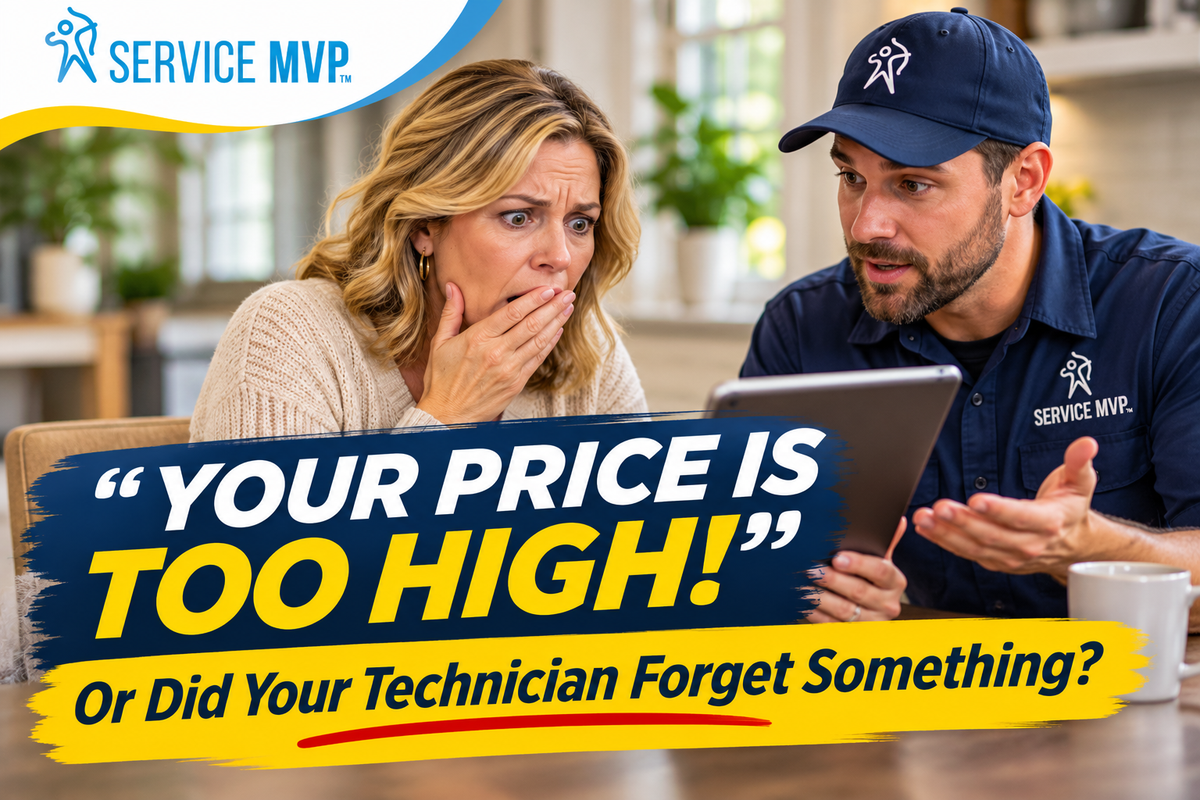
Your technician spends an hour diagnosing an air conditioning problem.
They identify the failed component, explain the repair, and present six professionally prepared options.
The homeowner studies the prices.
Then come the words every service technician hates hearing:
"Wow. You're expensive."
What happens next?
Does your technician defend the price?
Start explaining labor costs, insurance, trucks, and overhead?
Offer a discount?
Or assume the homeowner simply doesn't want to spend the money?
Here's something I want every HVAC, plumbing, and electrical contractor to understand:
When a customer says your price is too high, the price may only be a symptom of a much bigger problem.
And that problem might be something your technician forgot to do long before presenting the options.
Why Homeowners Say Your Service Prices Are Too High
Most homeowners don't know what professional HVAC, plumbing, or electrical service should cost.
They have an idea.
Maybe they remember what a repair cost ten years ago.
Maybe a neighbor mentioned paying less.
Maybe they searched online and found the price of a replacement part.
That number becomes their starting point.
Psychologists call this the anchoring effect: people use an initial number or piece of information as a reference point when evaluating something unfamiliar.
So when your technician presents a $2,400 repair, the homeowner may compare it to the $300 component they found online.
Naturally, the price feels high.
But that doesn't necessarily mean your company's price is unreasonable.
It means there's a difference between what the homeowner expected and what they now see.
Your technician's responsibility is to help the homeowner understand what they're purchasing—not simply announce what it costs.
And that requires more than explaining the part.
The Biggest Mistake Technicians Make When Presenting Prices
Let's imagine your technician is replacing a blower motor.
They explain the motor's specifications.
They describe how long they've been in the industry.
They talk about your company's warranties, insurance, and reputation.
All of those things matter.
But they've forgotten the most important part of the service call.
The people living in the home.
Think about it.
Why does that homeowner need a blower motor?
Because the motor failed?
Technically, yes.
But that's not the whole answer.
They need their heating and cooling system to work because people live in that house.
Maybe the bedrooms are uncomfortable at night.
Maybe someone works from home and struggles with the temperature.
Maybe the homeowner is concerned about keeping the house comfortable for visiting family.
The equipment matters because of what it does for the people who depend on it.
When technicians focus exclusively on the mechanical problem, they leave out the human reason the service matters.
And that's often where the value gap begins.
The Four Components of Value in Home Service Sales
During a recent Service MVP training session, I explained a way of thinking about value that helps technicians recognize what they may be overlooking.
There are four important components.
1. The Part or Equipment
This is what most technicians naturally discuss.
The capacitor.
The water heater.
The electrical panel.
The blower motor.
The drain line.
They explain what failed, why it failed, and what needs to be replaced.
That's necessary information.
But the part alone doesn't explain the complete value of professional service.
2. The Technician
Next comes the value of the person performing the work.
Their training.
Their experience.
Their diagnostic skills.
Their ability to install or repair the equipment correctly.
A qualified technician provides far more than a replacement component.
They provide expertise, judgment, and professional workmanship.
3. The Company
Then there's the value of the service organization.
Scheduling.
Customer support.
Insurance.
Warranty administration.
Training.
Service records.
And the ability to respond when the homeowner needs additional assistance.
These are legitimate parts of the service experience.
But here's where many technicians stop.
They've explained the part, themselves, and their company.
And they still haven't explained the most important reason the customer should care.
4. The People Who Benefit From the Solution
The final component is the homeowner and everyone affected by the problem.
What happens when the equipment isn't working?
How does that affect their daily routine?
What frustrations are they experiencing?
What would improve if the problem were solved?
This is where a technical repair becomes a meaningful solution.
In our training, I use illustrative percentages to show how technicians can concentrate too much on the equipment, themselves, and the company while overlooking the customer.
Those percentages aren't a scientific formula for measuring value.
They're a reminder that the people receiving the service must be central to the conversation.
People Are More Important Than Parts
This is one of the most important principles we teach at Service MVP.
People are more important than things.
More important than the motor.
More important than the gas valve.
More important than the company truck.
And more important than the technician's impressive credentials.
Because without the people living in that home, there wouldn't be a reason for the service call.
Let's take a plumbing example.
A homeowner has a shower valve that isn't functioning properly.
Your technician could explain the valve's internal components, the replacement procedure, and the manufacturer's warranty.
But what if the homeowner has three children getting ready for school every morning?
Now the problem has a different meaning.
The issue isn't simply a malfunctioning valve.
It's the inconvenience and frustration of a bathroom that isn't working the way the family needs it to.
When the technician understands that, they can explain the solution in terms the homeowner actually values.
Not just a new shower valve.
A properly functioning shower that helps the household get through its morning routine.
That's the difference between selling a part and solving a problem.
How to Connect With Homeowners Without Asking Intrusive Questions
I know what some technicians are thinking.
"Joe, I'm not comfortable asking people personal questions."
I understand.
Nobody wants to make a homeowner uncomfortable.
And technicians shouldn't interrogate customers or ask questions that have nothing to do with the service.
That's why I recommend beginning with the home itself.
Start with simple, natural questions:
- "How long have you lived here?"
- "How old is the home?"
- "How long have you owned it?"
- "Who normally uses this part of the house?"
- "How has this problem been affecting your routine?"
These questions help technicians understand the homeowner's situation without immediately getting personal.
Then something interesting happens.
The homeowner starts sharing information.
Maybe they've just moved in.
Maybe they've been renovating.
Maybe they mention that their family is visiting next month.
Now the technician has an opportunity to listen and ask a relevant follow-up question.
The key is genuine curiosity.
Not a memorized interrogation.
Not a sales script designed to manipulate someone.
Just a professional conversation with someone who needs help.
And if the homeowner prefers to keep things brief, respect that.
Connect the Problem to the People Before Connecting the Solution
Here's a simple process I want your technicians to practice.
First, identify the technical problem.
Second, understand how the problem affects the homeowner.
Third, explain how the proposed solution addresses both.
For example, suppose the technician discovers an air conditioning problem.
A purely technical explanation might sound like this:
"Your blower motor has failed. We need to replace it. Here's the price."
Now compare that with a more complete conversation:
"Mrs. Johnson, I found the reason your system isn't circulating air properly. The blower motor isn't operating as it should.
"You mentioned that the upstairs bedrooms have been uncomfortable at night. This problem is contributing to that issue because the system can't move air through the house properly.
"I've prepared several repair options so you can see the different ways we can address the problem."
Notice what's different.
The technician hasn't exaggerated anything.
They haven't invented a health concern.
They haven't pressured the homeowner.
They've simply connected a verified technical problem to something the homeowner said mattered.
That's how technicians communicate value without relying on sales pressure.
What to Do When the Customer Still Says You're Too Expensive
Now let's talk about what happens when your technician gets to the end of the presentation and hears:
"Your prices are outrageous."
This is where many technicians become defensive.
They explain why everything costs so much.
They blame inflation.
They compare their company to competitors.
Or they immediately start discounting.
But I want to suggest another approach.
Take responsibility for the possibility that you didn't explain the value clearly enough.
Imagine saying:
"Mr. Johnson, I think I may have made a mistake in how I explained this.
"I spent a lot of time talking about the equipment and the repair, but I don't think I did a very good job explaining how these options address the problems you've been experiencing.
"Would you mind if I went back through that with you?"
That's a very different conversation.
You're not arguing with the customer.
You're not accusing them of misunderstanding.
You're acknowledging that you may have communicated poorly.
And you're asking permission to correct it.
Sometimes that creates an opportunity to rebuild understanding.
Sometimes the customer will still decide the service is outside their budget.
Both outcomes are possible.
But taking responsibility is more productive than becoming defensive.
Stop Blaming Customers for Price Objections
This part of the lesson may be uncomfortable.
Good.
Sometimes we need to hear uncomfortable things.
When a technician consistently struggles with price objections, it's tempting to blame everything else.
"The customers in this neighborhood are cheap."
"Our prices are too high."
"Nobody wants to buy anything."
"The economy is terrible."
"We're not getting good leads."
Now, market conditions and household budgets absolutely affect purchasing decisions.
And companies must still make sure their pricing is competitive with the value they provide.
But those realities don't eliminate our responsibility to communicate effectively.
If we automatically blame every unsuccessful presentation on the customer, we never examine what we could improve.
In our training, we talk about moving through four stages:
Denial → Reframing → Acceptance → Solution
Denial sounds like:
"There's nothing I could have done. That customer was never going to buy."
Reframing sounds like:
"Maybe the customer didn't understand why the solution was worth the investment."
Acceptance sounds like:
"I may not have connected the problem and solution to what mattered to that homeowner."
And the solution sounds like:
"I'm going to practice asking better questions and explaining value more clearly."
That's how technicians improve.
Not by blaming themselves for every lost sale.
But by taking responsibility for the parts of the customer experience they can control.
Why Six Options Won't Fix a Weak Customer Conversation
At Service MVP, we teach technicians to build meaningful premium, mid-range, and economy options.
But here's something contractors need to understand.
Six options don't automatically create value.
A technician can prepare a beautiful option sheet and still fail to communicate why any of those solutions matter.
If all six choices are simply lists of parts and prices, the homeowner may still focus on the numbers.
That's why the observations and customer conversation matter so much.
The technician needs to understand the problems.
The homeowner needs to understand how those problems affect their home.
And each option needs to explain the relevant benefits and limitations.
Tools like OptionBuilder AI can help technicians organize their observations and present professional options that connect problems to solutions.
But software doesn't replace the need to listen.
It supports the communication process.
The technician still has to care about the person on the other side of the conversation.
A Training Exercise for Your Next Team Meeting
Here's something you can do with your technicians this week.
Give them this scenario:
A homeowner has an aging air conditioning system with a failed blower motor.
The technician has diagnosed the problem and prepared several repair options.
The homeowner says:
"That's way more than I expected."
Have one technician play the homeowner and another play the service professional.
Then practice three things.
First: Ask the homeowner what they expected and listen without arguing.
Second: Revisit the homeowner's concerns and explain how the proposed solutions address them.
Third: Ask whether the homeowner would like to review a different level of solution, discuss payment options if available, or take time to consider the choices.
Then switch roles.
Repeat the exercise until the technician can respond naturally.
This is the kind of practical communication training we emphasize during Service MVP's Total Immersion.
Because knowing what to say isn't the same as being able to say it confidently when a homeowner challenges your price.
The Real Reason Customers Buy Professional Service
Homeowners don't wake up excited to purchase a blower motor.
They don't dream about buying a new water heater.
And they don't look forward to spending money on electrical repairs.
They want a home that works.
They want comfort.
They want reliability.
They want the ability to go about their lives without constantly worrying about something breaking.
That's the real value of what we do.
And when technicians understand that, the conversation changes.
We're no longer trying to convince people that a part is worth a certain amount of money.
We're helping them understand how professional service can improve the place they live.
That's a much higher purpose.
And it's the foundation of Pure Motive Service.
Before You Lower Your Price, Improve Your Communication
The next time a homeowner says your company is too expensive, don't immediately assume your prices are the problem.
Take a closer look at the service conversation.
Did the technician understand the homeowner?
Did they connect the technical problem to the customer's experience?
Did they explain how each solution would help?
Did they listen?
Did they give the homeowner meaningful choices?
And did they take responsibility for anything they failed to communicate?
Because sometimes the missing ingredient isn't a discount.
It's helping the customer understand why the solution matters to them.
And that's something every service technician can learn to do better.
Help Your Technicians Communicate Value With Confidence
At Service MVP, we help home service contractors develop technicians who can connect with customers, explain solutions clearly, and present options without pressure.
Join MVP Club for weekly coaching, practical lessons, and opportunities to ask Joe Crisara and the Service MVP team questions.
Or explore our five-day Total Immersion training, where technicians practice the conversations that make a difference in customers' homes.
Your technicians shouldn't have to defend every price. They should know how to explain the value behind it.
