By Joe Crisara, America's Service Sales Coach and Author of What Should We Do?
Short answer
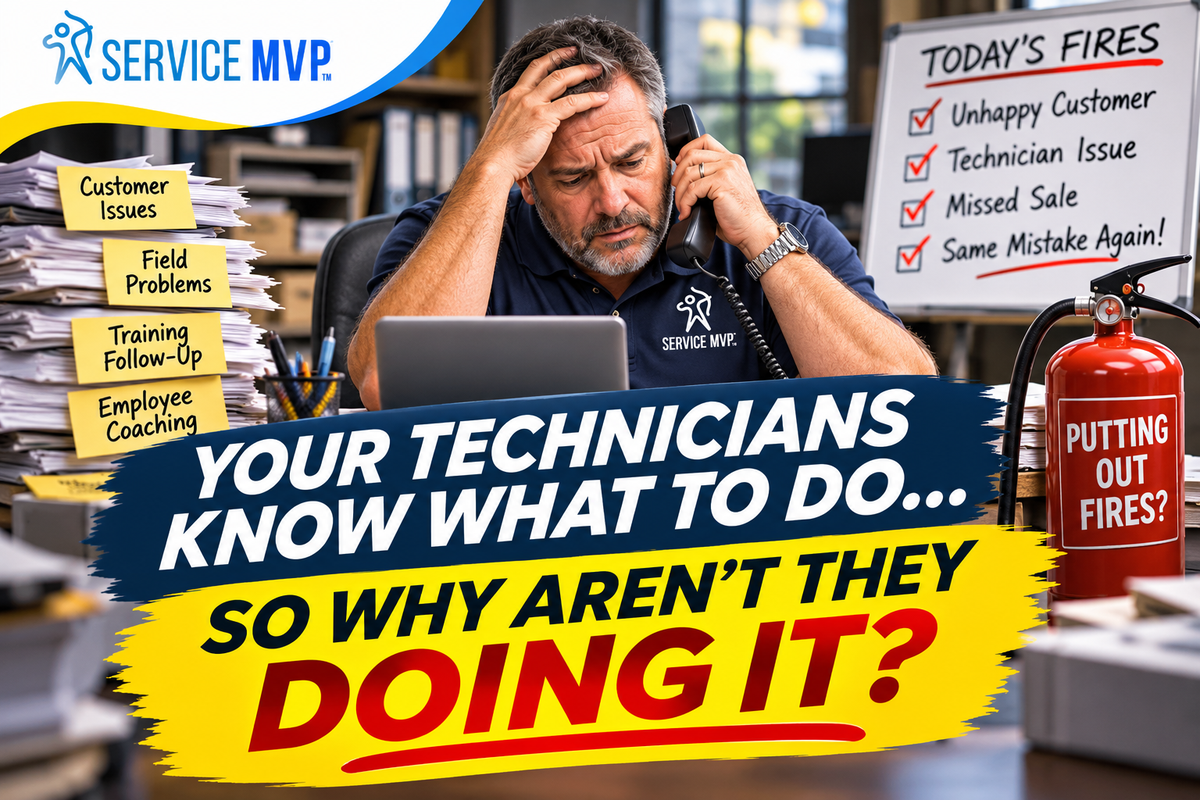
Why don't technicians do what they learned in training?
Your problem might not be the training. It might be what happens after the training. One of the biggest mistakes contractors make is confusing understanding a skill with being able to perform it.
You've invested thousands of dollars in technician training.
You've sent your HVAC technicians to classes. You've purchased sales training videos. You've held meetings, handed out workbooks, and explained exactly how you want your team to communicate with customers.
And everybody seemed to understand.
They nodded their heads. They asked questions. They might have even told you it was the best training they'd ever attended.
Then they went back into the field.
And nothing changed.
Your technicians are still struggling to present options. They're still discounting when homeowners question the price. They're still forgetting to ask important questions.
And you're wondering:
"How many times do I have to train these people before they actually start doing what they've learned?"
Here's something every home service business owner needs to understand:
Your problem might not be the training. It might be what happens after the training.
Why Technician Sales Training Doesn't Stick
One of the biggest mistakes contractors make is confusing understanding a skill with being able to perform it.
Think about a technician who attends a class on handling price objections.
They watch the instructor demonstrate the conversation.
They understand the lesson.
They might even pass a quiz.
But the next day, they're standing in a homeowner's kitchen.
The homeowner looks at the repair options and says:
"That's a lot more money than I expected."
Suddenly, the technician gets uncomfortable.
They start explaining why your company charges so much.
Or they immediately offer a cheaper option.
Why?
Because watching someone demonstrate a skill isn't the same as developing the ability to perform it yourself.
As Joe explains in our Make Training Stick training:
"Training isn't complete just because somebody attended the training. It's complete when they can demonstrate what they've learned."
And even then, the work isn't finished.
The skill has to show up during real customer conversations.
That's where coaching and accountability become essential.
The Hidden Cost of Training the Same Thing Over and Over
Many contractors think they're saving money by keeping technicians in the field instead of taking time for practice.
But consider the alternative.
What's the cost of a technician who can't explain the value of a premium repair?
What's the cost of a technician who immediately discounts when a customer questions the price?
What happens when someone fails to present appropriate options because they aren't confident explaining them?
These missed opportunities don't always appear as a line item on your financial statements.
But they can affect revenue, profitability, customer satisfaction, and employee development.
And when technicians repeatedly make the same mistakes, owners often respond by purchasing another training program.
The cycle continues.
You don't necessarily need more training content. You need a better system for putting the training you already have into practice.
Are You an Arsonist Fireman in Your Own Business?
Here's an uncomfortable question for business owners.
Are you constantly putting out fires that your employees should eventually be able to handle themselves?
Joe and I call this the Arsonist Fireman.
Picture an owner who's always rescuing someone.
A technician can't handle a difficult customer conversation, so the owner steps in.
A manager can't resolve an employee issue, so the owner takes over.
A complicated service call comes in, and suddenly everyone needs the owner.
The owner becomes the hero who saves the day.
But there's a problem.
Sometimes the owner is unintentionally creating the conditions that keep those fires burning.
Not because they want problems.
But because they're so busy solving today's problems that they never make time to develop employees who can solve tomorrow's.
And the cycle becomes:
Employees aren't trained → Problems occur → Owner rescues everyone → No time for training → Problems occur again.
The solution isn't to stop supporting your people.
It's to start developing their ability to succeed without constantly needing you.
Principle #1: Schedule Technician Training Like a Service Call
Let's start with something simple.
If you want training to happen consistently, put it on the calendar.
Think about how you schedule customer appointments.
You assign a technician.
You establish a time.
You protect that appointment.
You expect the work to be completed.
But how do many companies schedule employee development?
"We'll practice if everybody gets back early."
"We'll have a meeting when things slow down."
"We'll review that lesson when we have time."
And what happens?
Three weeks pass.
Nobody practices.
Then you're surprised when the team hasn't improved.
If you wouldn't schedule customer appointments that way, why would you schedule employee development that way?
Training doesn't need to consume an entire day.
Start with a manageable commitment.
For example, a company with eight technicians could build a simple weekly routine:
| Day | Training activity |
| Monday | 20-minute team meeting focused on one skill |
| Tuesday or Wednesday | 10 minutes of individual review or practice |
| During the week | Apply the skill during customer interactions |
| Friday | Manager reviews examples and provides coaching |
The important part isn't the exact schedule.
It's that somebody owns the process and follows through.
And remember, there are four activities to plan for: team training, individual learning, practice, and review.
Don't just schedule the lesson.
Schedule the practice and the follow-up, too.
Principle #2: Stop Asking Technicians Whether They Understand
Here's a question managers ask all the time:
"Does everybody understand?"
And what does everybody say?
"Yes."
That tells you almost nothing about whether they can actually perform the skill.
Instead, try this:
"Okay, I'm the homeowner. I just told you your repair price is too high. Show me what you're going to say."
Now you're going to learn something.
Can the technician respond naturally?
Do they listen?
Do they ask questions?
Do they immediately offer a discount?
Can they explain the solution without becoming defensive?
This is why we teach a five-step process for developing skills.
The Five Steps That Make Training Stick
Step 1: Learn
Introduce the concept through a lesson, video, workbook, or demonstration.
The technician needs to understand what to do and why.
Step 2: Repeat Back
Ask the technician to explain the concept in their own words.
Don't settle for a nod.
Have them tell you what they've learned.
This helps uncover misunderstandings before they become habits.
Step 3: Roleplay
Create a realistic customer situation and let the technician practice the conversation.
This is where the gaps become visible.
And that's a good thing.
You want to discover those gaps during practice, not for the first time in a customer's home.
Step 4: Implement
The technician uses the skill with real customers.
Now the lesson becomes part of the actual service experience.
Step 5: Review and Coach
The manager examines what happened.
What went well?
What needs improvement?
What should the technician practice next?
Then the process repeats.
Learn → Repeat Back → Roleplay → Implement → Review and Coach.
That's how training becomes a system rather than an event.
A Five-Minute Roleplay That Can Change a Customer Conversation
Let's make this practical.
Imagine a technician who struggles whenever homeowners question the price.
During training, the manager plays the homeowner.
Homeowner: "That's a lot more money than I was expecting."
Technician: "I understand. We might be able to do something less expensive."
Homeowner: "Okay, what can you take off the price?"
Stop the roleplay.
What just happened?
The technician assumed the customer needed a lower price.
But we don't actually know that.
Maybe the homeowner expected a minor repair.
Maybe they don't understand what's included.
Maybe they're comparing two different solutions.
Maybe they genuinely cannot afford the recommendation.
The technician hasn't asked.
Now the manager has something specific to coach.
Let's try again.
Homeowner: "That's a lot more money than I was expecting."
Technician: "I understand. When you say it's more than you expected, could you help me understand what you were comparing it to?"
Homeowner: "Well, I thought it was going to be a simple repair."
Technician: "That makes sense. Let's review what we found and what's included in the solution so you can decide what makes the most sense for you."
Notice the difference.
The technician didn't argue.
They didn't immediately discount.
They asked a question and stayed in the conversation.
And that improvement came from practicing the skill, getting feedback, and trying again.
That's what effective technician sales coaching looks like.
Why Roleplaying Matters Even When Your Technicians Hate It
Let's acknowledge something.
A lot of technicians don't enjoy roleplaying.
Some managers don't either.
It can feel awkward.
People worry about making mistakes in front of their coworkers.
But think about that for a moment.
Would you rather have your technician experience a little discomfort during a ten-minute practice session?
Or experience that same discomfort in front of a homeowner who's deciding whether to invest thousands of dollars?
Practice gives employees a safe environment to make mistakes, receive feedback, and improve.
And it doesn't have to take an hour.
A few minutes of focused practice can reveal something that another lecture never would.
The goal isn't to embarrass employees.
The goal is to help them become confident because they've successfully practiced the skill.
The Boiler Story: How Joe Turned One Technician Into Two
When Joe and I owned our service company, we had a technician who was particularly good at working on boilers.
Whenever a boiler call came in and that technician wasn't available, I'd ask Joe to handle it.
But Joe had a rule.
"If I'm putting my tool belt on, I'm taking another technician with me."
Why?
Because Joe didn't just want to fix the boiler.
He wanted to teach someone else how to fix it.
Eventually, instead of having only one technician who could handle those calls, we had two.
That's employee development.
And the same principle applies to communication skills.
When a technician struggles with presenting options, the manager shouldn't simply take over every presentation.
When someone struggles with a price objection, the manager shouldn't always be the person who rescues the sale.
Show the employee what to do.
Practice it together.
Give them feedback.
Then let them try.
The goal isn't for the manager to be great at every skill. The goal is to develop technicians who can perform those skills themselves.
Principle #3: Verify What Actually Happens in the Field
Here's where even well-intentioned training programs often fall apart.
The company schedules the meeting.
The technician learns the skill.
They practice it.
Everybody leaves feeling confident.
Then the technician returns to the field.
And nobody follows up.
A month later, the owner wonders why the training didn't work.
But here's the question:
Did anyone actually verify whether the technician used the skill?
At Service MVP, we emphasize coaching real customer interactions.
When appropriately authorized recordings are available, managers can review what actually happened.
Let's say the team has been practicing price objections.
The manager reviews a few relevant conversations.
Did the technician ask questions?
Did they listen to the homeowner's concern?
Did they explain the solution?
Or did they immediately move toward a cheaper option?
Now the manager has something concrete to coach.
And the coaching doesn't need to be complicated.
Start with something the technician did well.
Identify one thing to improve.
Then practice that one thing.
Not ten corrections.
One specific improvement.
And on the next call, look for progress.
If recordings aren't available, managers can use appropriate ride-alongs, observed roleplays, and structured reviews of recent customer interactions, recognizing that recollections are less reliable than direct observation.
The purpose isn't to catch employees making mistakes.
It's to help them become better at their jobs.
Stop Measuring Training Attendance. Start Measuring Behavior.
Many contractors measure training by activity.
How many classes did employees attend?
How many videos did they watch?
How many hours of training did we complete?
Those numbers tell you what the company provided.
They don't necessarily tell you what employees can do.
Instead, ask:
What skill did our technicians improve this month, and how do we know?
For example, if your team is learning to present service options, you might track whether technicians:
- Consistently explain their findings before presenting solutions.
- Present appropriate premium, mid-range, and economy options.
- Ask questions to understand customer concerns.
- Explain the benefits and limitations of each option.
- Give homeowners the opportunity to make informed decisions.
These are observable behaviors.
And when managers review them consistently, they can identify where additional practice is needed.
The objective isn't simply to improve an average ticket.
It's to develop better service conversations and more capable employees.
Revenue improvements may follow, but the immediate goal is to make sure the skills are actually being used.
Your Managers Don't Need to Become Full-Time Trainers
One concern we hear from contractors is:
"I understand what you're saying, but I don't have time to do all this."
That's reasonable.
Owners and managers are busy.
But making training stick doesn't require turning every manager into a full-time instructor.
It requires a repeatable process.
Choose one skill.
Schedule a short training session.
Have employees demonstrate it.
Give them an opportunity to use it.
Review the results.
Then coach the next improvement.
Your service manager, field supervisor, or lead technician may be able to facilitate much of this work.
The owner doesn't have to personally lead every session.
But someone must be responsible for making sure the process happens.
Otherwise, training becomes another good intention that disappears when the phones start ringing.
What Should You Train Your Technicians on First?
Don't try to fix everything at once.
Start with one skill that would make a meaningful difference in your customer experience.
For example:
- Asking better questions during the initial customer conversation.
- Explaining diagnostic findings in language homeowners understand.
- Presenting meaningful service and replacement options.
- Responding to price concerns without becoming defensive.
- Helping customers understand the benefits and limitations of different solutions.
Choose the skill your team needs most.
Then stay with it long enough for employees to demonstrate improvement.
As Joe says, he'd rather see a technician learn one important skill and use it successfully than complete ten lessons without changing anything.
Knowing more doesn't automatically mean doing better.
A Simple Training Plan You Can Start This Week
Here's what I'd like every contractor reading this to do.
First, open your calendar.
Schedule a 20-minute team training appointment.
Protect that time just as you would a customer appointment.
Second, choose one skill.
Don't attempt to cover everything your technicians need to improve.
Pick one behavior you want to see in the field.
Third, make somebody demonstrate it.
Have a technician explain the concept back to you.
Then roleplay a realistic customer conversation.
Offer feedback and let them try again.
Fourth, assign the skill to be practiced in the field.
Make sure everyone understands what they're working on.
Fifth, schedule the coaching follow-up.
Review a few relevant customer interactions.
Recognize what went well.
Identify the next improvement.
Then repeat.
You don't need to wait until you purchase another training program.
You can start using this process with the material you already have.
The Real Question Isn't Whether Your Technicians Have Been Trained
It's whether they can consistently perform what they've learned.
Think about your last training investment.
What changed afterward?
Can your technicians demonstrate the skills they were taught?
Are your managers observing those skills in real customer interactions?
Is someone providing feedback?
Or are you simply hoping the lessons will stick?
Because hope isn't a training system.
Training becomes valuable when it changes what employees actually do.
And that doesn't happen automatically when the class ends.
It happens when owners and managers make learning, practice, implementation, and coaching part of how the business operates.
That's how you develop technicians who don't just know what to do.
They actually do it.
Ready to Make Your Technician Training Stick?
At Service MVP, we help HVAC, plumbing, electrical, and other home service contractors turn training into practical skills their teams can use with customers.
Our Make Training Stick webinar explores how to schedule training, develop employee skills through practice, and reinforce those skills through ongoing coaching.
And if you're looking for a way to keep that process going, MVP Club provides training lessons, videos, supporting materials, and weekly live sessions with Joe Crisara.
You can also explore Total Immersion for intensive, hands-on technician training focused on customer communication, presenting options, and practicing real service conversations.
Don't just invest in what your technicians know. Invest in what they can do.
