
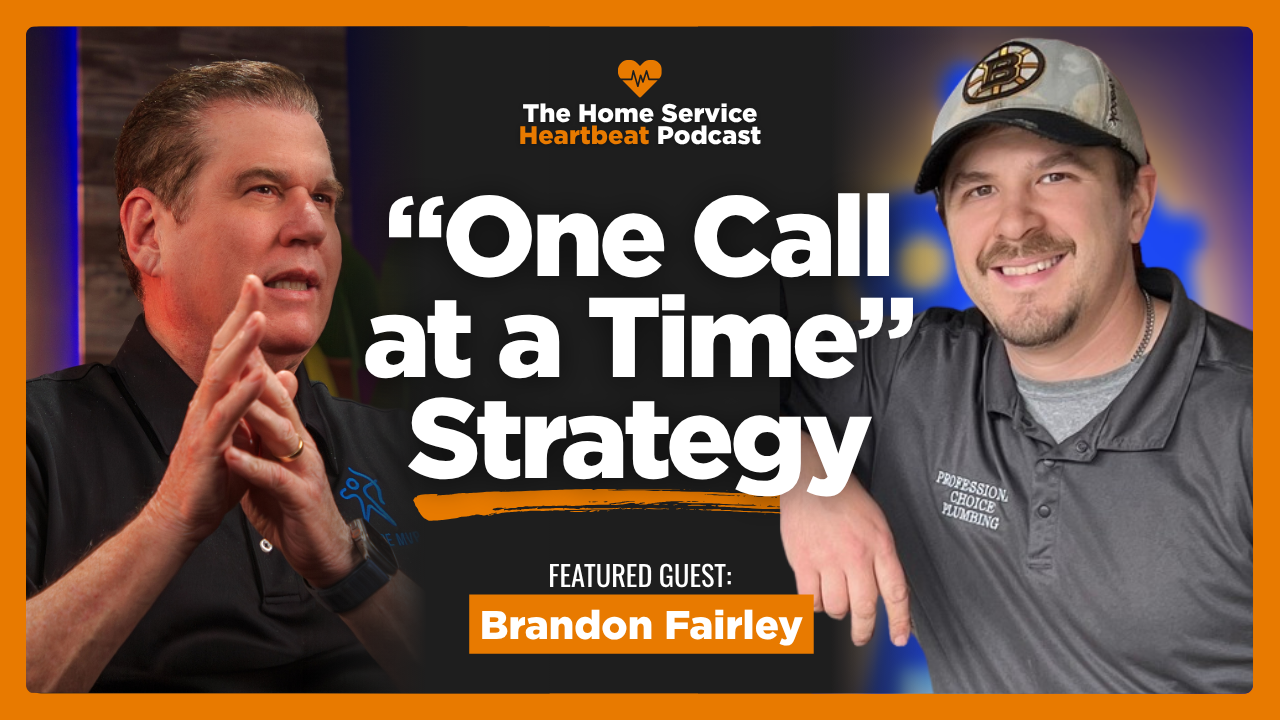
From Tradesman to Business Owner: How Brandon Farley Built a Customer-First Plumbing Company
From Tradesman to Business Owner: How Brandon Farley Built a Customer-First Plumbing Company
By Joe Crisara, Author of What Should We Do? and Co-Founder of Service MVP
When Brandon Farley moved to Florida to start Professional Choice Plumbing, he didn't arrive with a giant team, an established customer base, or decades of brand recognition in the community.
As Brandon put it, he arrived with “a truck, some tools and a dream.”
Professional Choice Plumbing opened in late 2022 in Ocala, Florida. But Brandon wasn't interested in simply building another plumbing company.
He wanted to build one differently.
His philosophy was surprisingly simple:
One call at a time.
Don't rush the plumber.
Don't treat the homeowner like another stop on the schedule.
Don't fix the obvious problem and race to the next call.
Slow down. Ask questions. Investigate. Understand what's really happening. Give the homeowner choices.
Then let the customer decide.
When Brandon joined me on the Home Service Heartbeat Podcast, we talked about how that philosophy has influenced everything from technician training and hiring to leadership, diagnosis, options, and even how he thinks AI will change the plumbing industry.
And there are some important lessons in his story for almost any home service company.
The Customer in Front of You Should Be the Priority
One thing Brandon said during our conversation immediately stood out to me.
At Professional Choice Plumbing, technicians aren't supposed to be thinking:
“What's my next call? I have to get out of here.”
Instead, Brandon wants them focused on the customer they're serving right now.
That's a very different way to operate a service business.
Home service companies naturally worry about efficiency.
How many calls can we run?
How quickly can we get to the next customer?
How do we fit one more appointment into today's schedule?
Those are legitimate operational questions.
But there's a point where efficiency starts working against you.
When technicians feel rushed, some of the first things to disappear are the behaviors that create a great service experience:
Questions.
Listening.
Investigation.
Explanation.
Choices.
That's exactly why we've talked about how rushing technicians between calls can cost you revenue.
Brandon's approach is essentially the opposite:
Protect the call that's happening now.
Sometimes the Obvious Problem Isn't the Whole Problem
Brandon shared a story from the company's first few months that demonstrates why this matters.
A homeowner had a water-softener failure that sent resin throughout her home's plumbing system. Multiple plumbers had reportedly been there during the course of about a week trying to flush the system, but the problem continued.
Brandon went to the home, spent time investigating what was happening, identified the root problem, and ultimately resolved it. The homeowner became a long-term customer.
There's an important distinction there.
Fixing the symptom isn't always the same as solving the problem.
That's why Brandon says his plumbers don't simply walk into a house, repair whatever the customer initially called about, and leave.
They investigate.
Treat the Home More Like a Doctor Treats a Patient
Brandon used an analogy during our conversation that I really liked.
Suppose you cut your finger and go to the doctor for stitches.
The doctor doesn't necessarily look only at your finger.
Depending on the visit, they may check things such as your blood pressure, heart rate, height, weight, or other basic health indicators.
Why?
Because they're responsible for looking at more than the single symptom that brought you through the door.
Brandon believes plumbing service should work similarly.
If a homeowner has a leaking faucet, Professional Choice Plumbing may ask:
Has this happened before?
What's the water pressure?
What's the water quality?
Is there an underlying condition contributing to repeated failures?
The homeowner called about the faucet.
But the faucet may only be the symptom.
That doesn't mean inventing additional problems.
It means doing enough investigation to understand whether additional legitimate conditions exist.
That's something we've been talking about a lot at Service MVP.
Sometimes technicians who appear to have a sales problem actually have an opportunity-identification problem.
If you never discover the condition, you can never explain the solution.
Better Service Starts With Better Questions
Brandon also made another important point:
You can't customize a solution without understanding the customer.
Suppose the water heater isn't working.
A technician could immediately recommend a tankless water heater.
But why?
Does the homeowner run out of hot water?
How many people live there?
What problems are they experiencing?
What matters to them?
Without asking questions, the technician is recommending a product.
With better questions, the technician can recommend a solution.
As Brandon explained, he doesn't want his plumbers going into homes acting like salespeople. He wants them offering solutions that make sense for that particular customer—and the only way to know that is to ask.
That distinction is at the heart of Pure Motive.
The purpose of asking questions isn't to uncover something else you can sell.
It's to understand enough to help.
Give the Homeowner Information and Let Them Choose
Once the technician understands the home and homeowner better, the next question becomes:
What should we do about it?
Brandon said Professional Choice Plumbing generally tries to provide three to five options on a job when appropriate.
The higher options may address more of the customer's concerns, provide longer warranties, and create greater peace of mind.
Other options may address less.
And the most basic choice might simply solve the immediate reason the homeowner called.
That's important.
The technician isn't saying:
“You have to do all of this.”
They're saying:
“Here's what we found. Here are different ways we can address it. Which approach makes the most sense for you?”
That's also why I believe presenting multiple options creates a better customer experience than simply handing the homeowner one price.
One price creates a yes-or-no decision.
Meaningful options create choices.
You Can't Deliver a Five-Star Experience Without Training
Brandon wants Professional Choice Plumbing to deliver what the company describes as a five-star experience.
But putting that promise on a website is easy.
Getting employees to deliver it consistently is much harder.
Brandon acknowledged one of the biggest challenges of ownership: taking what's in the owner's head and getting other people to understand it, repeat it, and execute it consistently.
That's where training comes in.
For someone entering the trade without plumbing experience, Brandon said Professional Choice may invest a couple of years developing that person as an apprentice before they're expected to work independently.
Training doesn't end there.
Brandon said the company holds two to three training sessions a week, some voluntary, and also takes advantage of specialized vendor training. He said he's willing to shut down for a day or half-day when worthwhile equipment training will make his team more competent.
That's a very different philosophy from:
“We trained everybody last year.”
Training isn't an event.
It's part of operating the company.
We've just explored this exact problem in Why Doesn't Technician Training Stick?
Skills have to be taught, practiced, reinforced, and developed over time.
Train the Plumber AND the Communicator
There's another reason Brandon's approach matters.
Being technically excellent isn't enough to create an excellent customer experience.
A service professional needs both sides.
Technical competence + communication competence.
The plumber has to diagnose and perform the work correctly.
But they also have to listen.
Ask questions.
Explain what they found.
Understand what matters to the homeowner.
Present choices.
Answer concerns.
And help the customer understand what happens next.
A technically brilliant plumber who can't communicate may leave the homeowner confused.
A great communicator without technical competence is an even bigger problem.
The best service professionals develop both.
Build Careers, Not Just Jobs
Training at Professional Choice Plumbing also connects directly to Brandon's leadership philosophy.
When I asked what kind of people he wants to hire, Brandon didn't say:
“Someone who already knows everything.”
He said he wants someone who wants plumbing to be a career.
He doesn't want to invest heavily in someone who's simply looking for a temporary job. He wants people who can develop a skill, support themselves and their families, earn a good living, and be proud of where they work.
That's an important leadership lesson.
If you want employees to invest themselves in your company, what are you investing in them?
Leadership Starts With Understanding What Your People Want
Brandon describes his approach as servant leadership.
That means understanding the goals of the people who work for him.
During our conversation, he shared the example of an employee whose goal was to buy his first home and put roughly half down. Brandon said the employee was getting close to achieving it.
That may seem unrelated to plumbing.
It isn't.
Your employees have goals.
Buying a house.
Supporting a family.
Advancing their career.
Becoming a leader.
Building financial security.
Mastering their trade.
If the company can help employees progress toward those goals, work becomes more than someplace they have to show up every morning.
Brandon's belief is that if he helps his employees reach their goals, they'll be happier, want to come to work, and ultimately help the company reach its goals too.
What Happens When the Owner Can't Be on Every Call?
This may be one of the hardest transitions from tradesman to business owner.
When you're the technician, you control the experience.
You know what questions to ask.
You know what to inspect.
You know how you want the homeowner treated.
Then you hire five people.
Ten people.
Twenty people.
Suddenly, you can't personally deliver every experience.
Your company has to deliver it without you.
That's why systems, training, leadership, accountability, and technology become so important.
And it's also why something Brandon said about AI caught my attention.
Brandon Thinks AI Will Enhance the Plumber - Not Replace One
When I asked Brandon about the future of plumbing, AI was one of the first things he mentioned.
But he doesn't envision AI replacing plumbers.
He imagines AI supporting them in the field.
He described a future where a plumber might have technology—perhaps even something like smart glasses—that can listen and observe during the call and provide prompts:
Did you check the water pressure?
Did you evaluate the water conditioning?
Did you investigate potential underlying problems?
The purpose wouldn't be to do the plumbing.
It would help the plumber deliver a more complete and consistent service experience.
I think that's an important distinction.
The best use of AI in home services may not be replacing the service professional. It may be helping a good service professional become more consistent.
That's very close to how we think about technology at Service MVP and with OptionBuilder AI.
Technology shouldn't replace the conversation.
It should make it easier for the technician to execute the process.
From Doing the Work to Building the Company
Toward the end of our conversation, I asked Brandon what advice he'd give his younger self.
His answer was simple.
Take it seriously sooner.
Brandon entered plumbing around age 21. He said that during roughly his first six years, he treated plumbing primarily as a job.
Then something changed.
He decided:
“I'm just gonna be the best at this I can be.”
And he said things began changing for him.
He wishes he'd made that decision years earlier.
There's probably a lesson there for more than plumbers.
At some point, growth requires deciding that you're no longer simply going to do the work.
You're going to master it.
Then eventually, if you become an owner, another transition happens.
You have to stop being the only person capable of delivering your standard.
You have to build a company capable of delivering it.
That's what Brandon is working to do at Professional Choice Plumbing.
One customer.
One technician.
One call at a time.
Watch the Full Conversation With Brandon Farley
There's much more in our conversation about Brandon's journey through the trades, building Professional Choice Plumbing, hiring and developing plumbers, servant leadership, AI, customer service, and what he's learned since becoming a business owner.
