
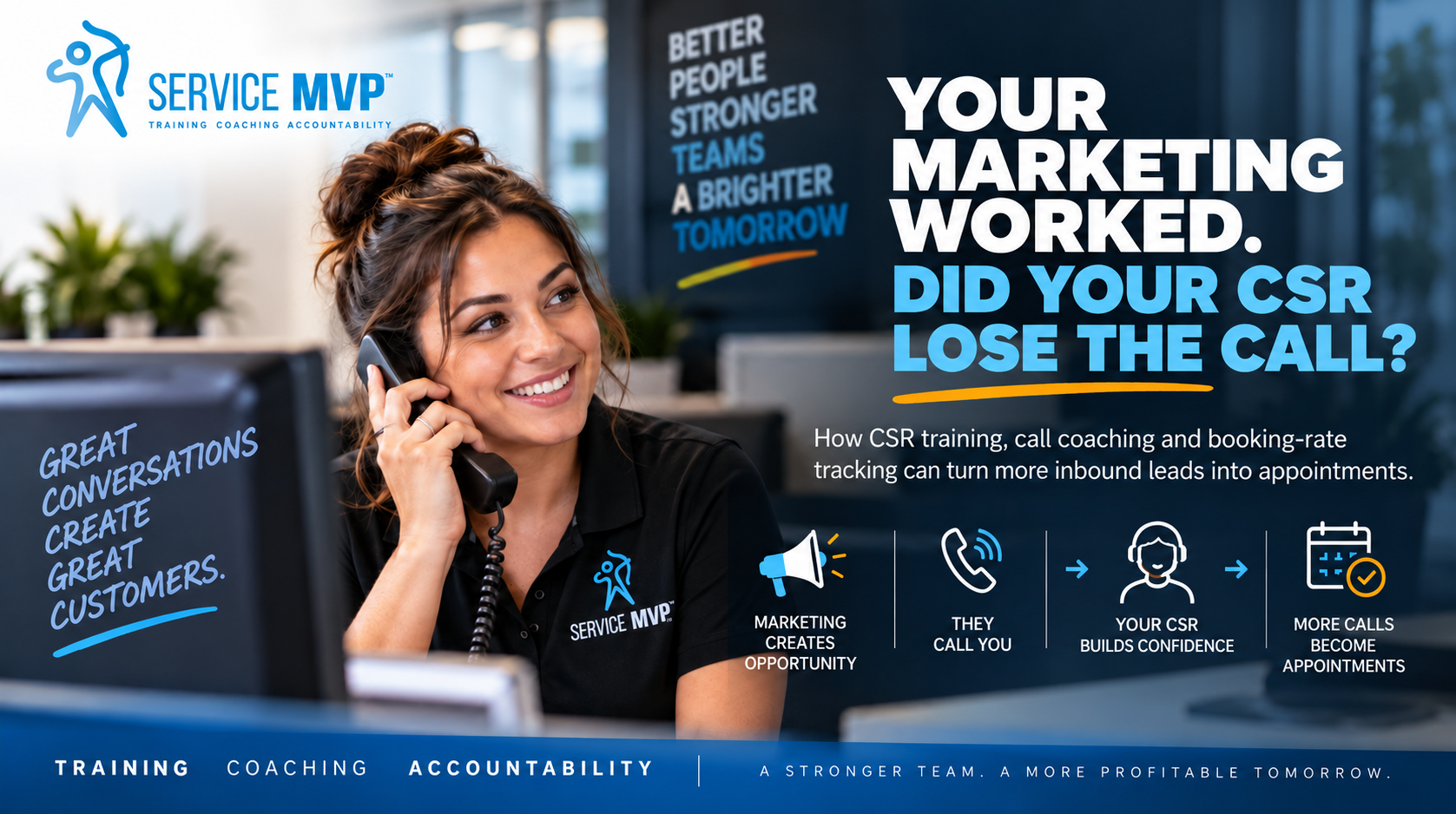
Your Marketing Worked. Did Your CSR Lose the Call?
Your Marketing Worked. Did Your CSR Lose the Call?
By Joe Crisara, Author of What Should We Do? and Co-Founder of Service MVP
You paid for the marketing.
The homeowner saw your ad, found you on Google, received a referral, noticed one of your trucks or remembered your company from somewhere else.
They picked up the phone.
They called you.
Marketing did its job.
Now there is one question:
What happened when someone answered the phone?
Home service companies spend enormous amounts of time talking about generating leads. More Google Ads. Better SEO. More reviews. Direct mail. Social media. Referral programs.
But generating the lead is only half the equation.
If 100 homeowners call your company and your customer service representatives book only 60 of them, getting another 20 leads isn't necessarily the first problem you should solve.
You may already have more opportunity than you realize.
It's just disappearing on the phone.
A Lead Isn't Valuable Until Someone Does Something With It
Owners tend to think about marketing in terms of cost per lead.
That's important.
But I'd encourage you to follow that lead one step further.
What did it cost you to generate a booked call?
Those aren't necessarily the same number.
Imagine spending $10,000 to generate 100 inbound opportunities.
If 80 become appointments, you're paying $125 per booked call.
If only 50 become appointments, you're paying $200.
Same marketing.
Same $10,000.
Completely different result.
That's why a CSR isn't simply answering phones.
Your CSR is part of your revenue system.
And when we treat that position like an administrative function instead of a professional skill, we can spend thousands of dollars generating opportunities only to lose them before a technician ever gets into the truck.
Answering the Phone Is Not the Same as Booking the Call
A customer calls and says:
"How much do you charge to come out?"
The CSR answers the question.
The customer says:
"Okay, I'll call you back."
And the call ends.
Was the CSR polite?
Probably.
Did they answer the customer's question?
Yes.
Did they serve the customer?
Not necessarily.
Because we don't even know why the customer called.
Maybe their air conditioner stopped working and they have an elderly parent living in the home.
Maybe there's water leaking through the ceiling.
Maybe half the house has lost power.
Maybe their garage door won't close and they're worried about leaving the house unsecured.
Maybe they have three children and no hot water.
The price of the service call wasn't necessarily the real problem.
It was simply the first question the homeowner knew how to ask.
A great CSR learns what's behind the question.
Don't Race to Answer the First Question
One of the most important communication skills we teach at Service MVP is connection before transaction.
That applies in the home.
And it applies on the phone.
When a homeowner asks about price, availability or how long something will take, the CSR doesn't need to dodge the question.
But they also don't have to treat the conversation like a vending machine:
Customer inserts question. CSR dispenses answer.
Instead, become curious.
"Absolutely, I can help you with that. Tell me a little bit about what's happening."
Now we're having a conversation.
What happened?
When did it start?
Is everyone safe?
Has someone already looked at it?
What is the customer most concerned about?
The objective isn't to interrogate the homeowner.
It's to understand why they called so you can actually help.
The CSR Has to Create Confidence Before the Technician Arrives
Think about the customer's perspective.
Something in their home isn't working.
They probably didn't plan for this today.
They may already be frustrated.
They don't know who is going to show up.
They don't know what this will cost.
And they don't know whether they can trust the company they're calling.
The CSR is often the first human being representing your company.
That means the customer experience begins before the truck leaves the parking lot.
Tone matters.
Energy matters.
Listening matters.
Empathy matters.
Confidence matters.
Accuracy matters.
If the CSR sounds rushed, annoyed, uncertain or uninterested, the customer feels it.
If the CSR sounds confident, curious and genuinely interested in helping, the customer feels that too.
Before your technician ever gets a chance to demonstrate value, your CSR has already begun establishing - or weakening - the customer's confidence in your company.
Stop Treating the Service Fee Like Something to Apologize For
This is another place calls can fall apart.
The customer asks:
"Do you charge a service fee?"
And suddenly the CSR's voice changes.
"Well...yes. Unfortunately, we do have a $___ fee..."
Unfortunately?
Why?
If your company sends a trained professional in a stocked vehicle to a customer's home to evaluate a problem, there is a cost associated with delivering that service.
You don't have to be defensive about it.
You also don't need to make the fee the centerpiece of the conversation.
Help the customer understand what happens when your professional arrives.
What will they do?
What can the customer expect?
How does the process work?
What happens after the problem is evaluated?
Price makes more sense when customers understand what they're receiving.
That's as true on the telephone as it is when a technician presents a repair.
The Goal Isn't to "Close" the Caller
I don't want CSRs thinking their job is to pressure every caller into an appointment.
That's not the point.
Their job is to help the person calling make a good decision about the next step.
Sometimes that will mean booking the call.
Occasionally, it may mean your company isn't the right fit.
Pure Motive doesn't disappear because we're talking about a CSR instead of a technician.
Listen first. Understand the situation. Explain how you can help. Make the next step clear. Then allow the customer to choose.
There's a big difference between:
"How can I get this person booked?"
and:
"How can I help this person?"
Ironically, the second mindset often makes the first result much easier.
Are Your CSRs Actually Asking for the Appointment?
This sounds almost too simple.
But listen to enough calls and you'll hear it.
The CSR answers questions.
Explains the fee.
Talks about availability.
Maybe even has a nice conversation.
And then waits for the customer to somehow book themselves.
At some point, somebody has to make the next step easy.
"I can have someone there tomorrow between 10 and 12. Would that work for you?"
That's not pressure.
That's service.
The customer called because they need help.
If you can help, help them move forward.
Don't leave them standing at the doorway because your CSR was afraid to invite them through it.
Company-Wide Booking Rate Can Hide the Real Problem
Let's say your company books 72% of incoming opportunities.
Is that good?
Maybe.
But that number alone doesn't tell me enough.
Suppose CSR #1 books 86%.
CSR #2 books 79%.
CSR #3 books 51%.
Your "company booking rate" just hid a coaching opportunity.
The same thing can happen by call type, day of week, marketing source or time of day.
Maybe booking collapses after 4 p.m.
Maybe membership customers book at a very high rate while new customers don't.
Maybe calls generated from one marketing source behave differently from another.
Maybe the problem isn't the CSR at all. Maybe customers are consistently declining because the schedule is booked for four days.
Numbers should help you find the behavior behind the result.
That's why I don't want owners merely looking at a booking-rate percentage.
I want them asking:
Why is it that number?
Don't Use Recorded Calls Only When Something Goes Wrong
Many home service companies record their calls.
Then nobody listens to them unless a customer complains.
That's a wasted coaching tool.
Your recorded calls contain the actual customer experience.
Listen to successful calls.
What did the CSR do well?
Where did connection happen?
What questions opened the conversation?
How did they explain the service fee?
How did they transition into booking?
Then listen to calls that didn't book.
Where did the conversation change?
Did the CSR answer a price question too quickly?
Did they miss what the customer was really concerned about?
Did they fail to explain the value?
Did they ever ask for the appointment?
Did they sound confident?
Don't use call recordings to catch people doing something wrong. Use them to help people get better.
That's coaching.
Role-Play Isn't Just for Technicians
We've talked a lot about technicians needing to practice customer conversations.
Your CSRs need practice too.
What happens when the customer says:
"I need to talk to my husband."
"Your service fee is too high."
"Another company doesn't charge to come out."
"I just want a ballpark price."
"Can you tell me what a water heater costs?"
"I need somebody today."
"I'm calling around."
Those situations shouldn't surprise your team.
Practice them.
Not so the CSR can memorize the perfect comeback.
Practice so they can become comfortable listening, asking questions, explaining value and helping the customer move forward without sounding scripted.
You wouldn't want a technician learning how to handle an objection for the first time while standing in a customer's kitchen.
Why would you want your CSR learning it while your marketing dollars are on the phone?
What Happens to the Calls That Don't Book?
This may be one of the biggest missed opportunities of all.
A homeowner calls.
They don't book.
Then what?
In many companies:
Nothing.
The lead disappears.
But "didn't book" doesn't necessarily mean "will never book."
Maybe the homeowner wanted to check with a spouse.
Maybe they were comparing companies.
Maybe your schedule didn't work.
Maybe they weren't ready.
Maybe they got interrupted.
Maybe nobody clearly asked for the appointment.
At minimum, you should know why the call didn't book.
And when appropriate, there should be a follow-up process.
A text.
A call.
An email.
A reminder.
Whatever makes sense for the situation.
You already paid to create the opportunity.
Don't throw it away simply because the customer didn't say yes during the first conversation.
Before You Spend Another Dollar on Leads, Look at What You Already Have
I'm not saying stop marketing.
A growing home service business needs opportunities.
But when owners tell me:
"We need more leads."
I want to know what happened to the leads they already had.
How many calls came in?
How many were answered?
How many were legitimate opportunities?
How many booked?
How many didn't?
Why didn't they?
Who handled them?
Did anyone follow up?
What was each CSR's booking rate?
What happened after hours?
Those questions can uncover revenue that doesn't require another dollar of advertising.
Sometimes the fastest way to grow isn't generating more opportunity.
It's getting better at serving the opportunity you've already created.
Your Marketing Worked. What Happens Next Is Up to Your Team.
The phone ringing is a victory.
But it's a very early victory.
The customer still needs someone who will listen.
Someone who will understand why they're calling.
Someone who can confidently explain how the company can help.
Someone who will make the next step easy.
Someone who will ask for the appointment.
And someone who will follow up when the customer isn't ready yet.
That's not "just answering phones."
That's a professional skill.
Train it like one.
Coach it like one.
Measure it like one.
Because before you ask marketing to send you another hundred leads, make sure your team knows what to do with the hundred you're already getting.
Want to Turn More Opportunities Into Great Customer Experiences?
Service MVP helps home service companies coach the behaviors behind their numbers - from the first customer conversation through the service call and beyond.
Through Service MVP Coaching, leaders learn how to observe performance, coach their teams, create accountability and develop repeatable customer-service behaviors instead of simply telling people to "do better."
